ChiroGrowth Command
Make a planning assumption explainable.
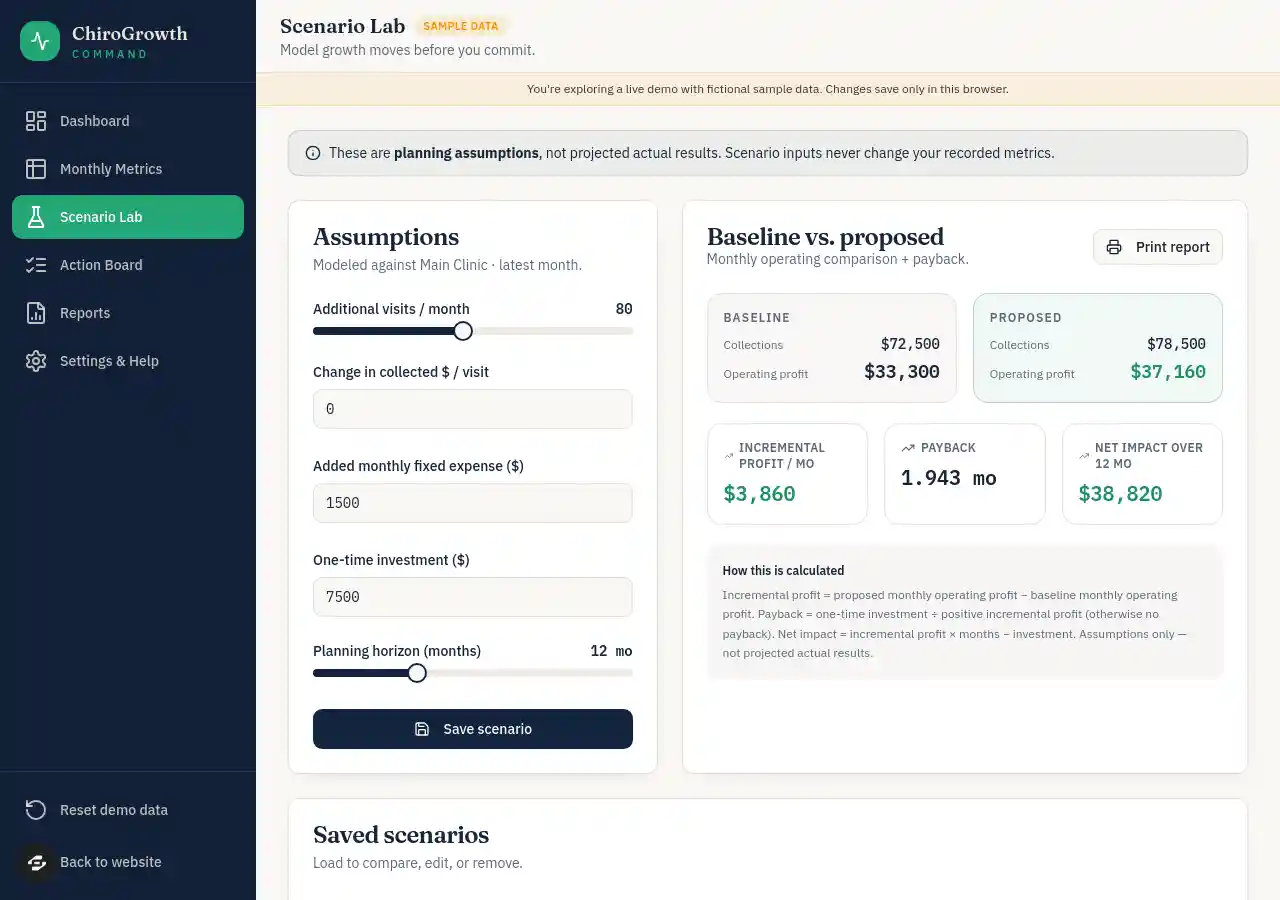
Inspect the visits, costs and profit behind a fictional business scenario.
Connect your assistant to create an app, inspect its progress, request changes and publish the result. Start with a clear brief, then check the actual app in a browser before sharing it.
Builds and changes use the connected workspace’s access and credits. Check current pricing before starting.
MCP lets your assistant use Overskill’s tools through an authorized connection. Follow your host’s setup at /connect and complete OAuth sign-in.
https://mcp.overskill.com/mcp
Tools act on the connection’s team. Access, permissions and available credits still apply; a successful read does not establish permission to create.
Check my connected Overskill workspace, available tools, balance and apps. Do not start a build yet.get_balance and list_apps are useful first reads. Missing access should be resolved before requesting a build.
These public apps were built and revised through MCP. The screenshots show fictional data; the case study separates observed checks from remaining gaps.
ChiroGrowth Command
Inspect the visits, costs and profit behind a fictional business scenario.
ChiroPartner Pipeline
Inspect a completed sample workshop alongside upcoming events and their next steps.
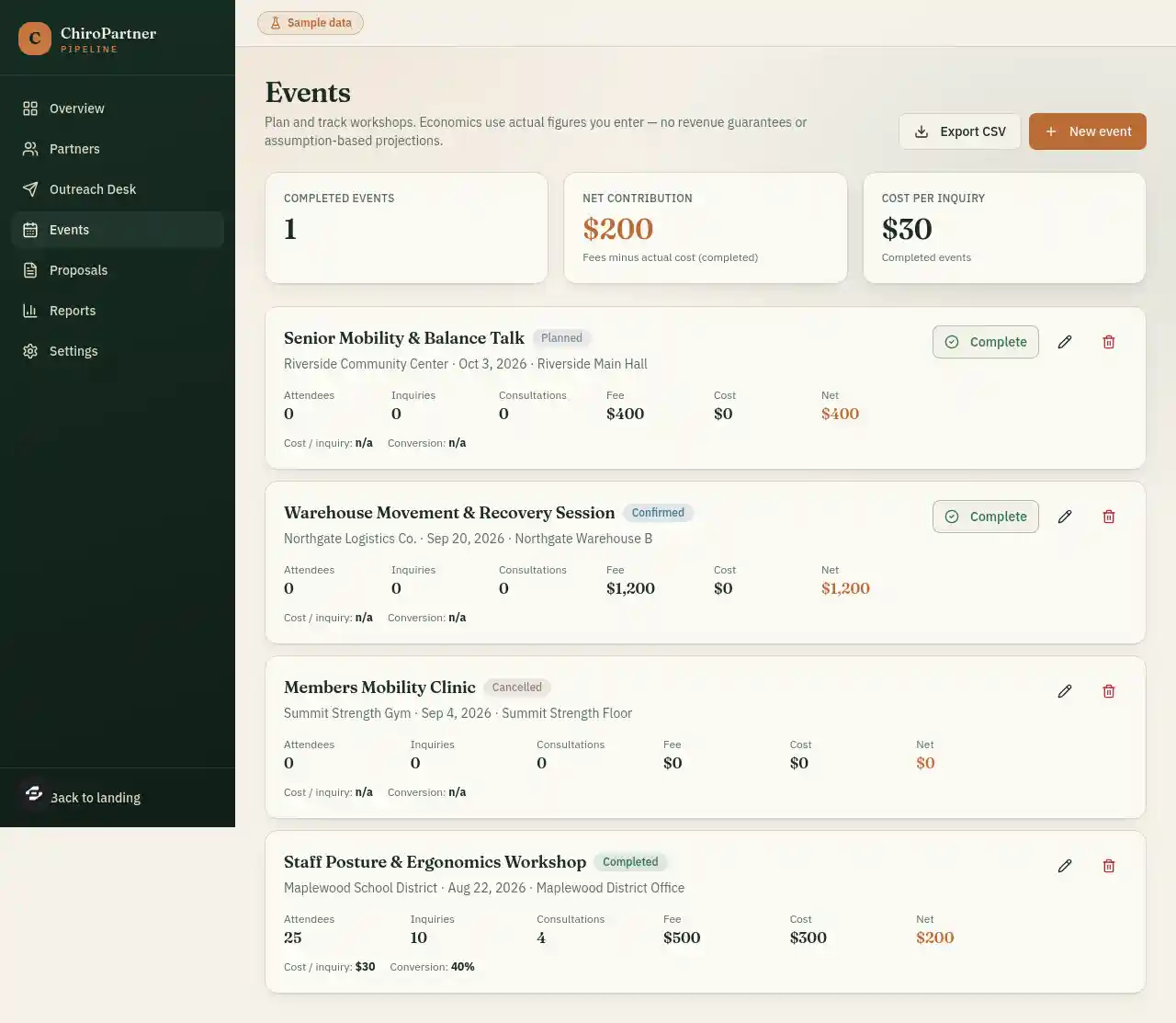
Creating a copy requires sign-in and account access. See the case study for the checks performed and remaining work.
Choose one person, one record and one change. Define the expected result before building. Add services such as payments or email only after checking their account setup, permissions and behavior.
Build, test and publish an app through MCP gives you the complete method.
After an authorized create_app request, keep build_id and inspect get_build / get_app before starting another copy.
Use a browser to test the expected change, save and reload; compare the result with your brief.
Use update_app for a specific failure on the same build. Review further credit use and repeat the failed check.
After review, request publish_app, inspect the public URL and repeat the important checks. Hand over the tested scope and remaining work.
/?prompt=… link prefills an unsent composer. They review it and complete the required sign-in, access and credit steps before submitting.
Use a team-scoped API key with the required permissions. This example queues real build work if you run it with valid access; it can consume credits. Keep the key out of shared prompts and source files.
curl -X POST https://www.overskill.com/api/v1/generation_queue \
  -H "User-Agent: OverSkill/206fd15 (+https://overskill.com)" \
  -H "X-API-Key: os_your_key_here" \
  -H "Content-Type: application/json" \
-d '{"prompt":"Build a coffee shop landing page with hours and a menu"}'{
"job_id": "example_job_id",
"app_id": "example_app_id",
"message_id": 456,
"status": "queued",
"status_url": "https://www.overskill.com/api/v1/generation_queue/example_job_id",
"app_url": "https://www.overskill.com/account/apps/example_app_id/edit"
}Identifiers vary. This shortened response is illustrative, not an observed build. Completion time varies; the API’s estimate is not a measured result for your app.
Poll status_url with the same authorized credential about every 15 seconds. On completed, inspect app.preview_url. Stop on failed or cancelled and inspect the result before retrying. Build completion is not publication or browser acceptance.
Manage keys in Team Settings → API Keys. API documentation describes permissions and response fields; MCP setup uses OAuth instead.
Read SKILL.md or follow your host’s setup instructions. A downloaded skill does not grant account access or connect a tool.
Public documentation and discovery can be read without a key. The email sign-in endpoint starts authentication; it does not grant builder access. Builds require an authorized account and credits.
Discovery files describe interfaces and authentication. A published declaration does not establish successful execution or grant permission to act.
/connect
Connect URL, per-host add flow (Grok Bot, OpenClaw, Hermes Agent, Cursor, Claude, ChatGPT), OAuth, what you can do
/robots.txt
Explicit AI bot allow rules + Cloudflare Content-Signal directive
/sitemap.xml
Templates, integrations, /build/* landing pages, more
/integrations
1,540 integrations — Composio-powered OAuth connectors plus direct payments, email, and AI. Catalog coverage does not mean every connection is configured for your app.
/.well-known/mcp/server-card.json
Tool catalog endpoint + auth methods
/.well-known/agent-skills/index.json
Discovery RFC v0.2.0 — $schema + skills array with sha256 digests
/.well-known/oauth-authorization-server
RFC 8414 metadata
/.well-known/oauth-protected-resource
RFC 9728 metadata
/.well-known/api-catalog
RFC 9727 — linkset+json over all our APIs
/auth.md
How agents obtain credentials — OAuth + PKCE, bearer tokens, verified-email identity
/openapi.json
Describes hosted checkout surfaces; not native agent settlement
/.well-known/acp.json
Agentic Commerce Protocol discovery document (OpenAI + Stripe)
/.well-known/ucp
Universal Commerce Protocol profile (Google + Shopify)
/SKILL.md
Anthropic/OpenAI Agent Skills format
/llms.txt
Concise LLM-friendly ref
/llms-full.txt
Exhaustive LLM-friendly ref
Eligible successful and redirect responses include discovery Link: headers. Errors and selected callback and health paths are excluded.
Link: </SKILL.md>; rel="alternate"; type="text/markdown", </.well-known/mcp/server-card.json>; rel="describedby"
Send Accept: text/markdown on a public template page and we return clean markdown — no HTML chrome to strip.
curl -H "Accept: text/markdown" https://www.overskill.com/templates/<slug>
Commerce discovery documents describe existing hosted checkout surfaces. Native agent payment and transaction protocols remain planned; publishing metadata does not implement those transactions.
Tool catalog + execution endpoint discoverable via /.well-known/mcp/server-card.json (legacy /.well-known/mcp.json kept for backwards compat). Use the hosted authenticated Streamable HTTP endpoint.
Conformant SKILL.md served at /SKILL.md. Discovery index at /.well-known/agent-skills/index.json with $schema + sha256 digests. Legacy agentskills.io v1.0 card kept at /.well-known/agent-skills.json for backwards compat.
RFC 8414 — published at /.well-known/oauth-authorization-server. Doorkeeper-backed authorization_code flow.
RFC 9728 — published at /.well-known/oauth-protected-resource. Bearer token auth.
Published at /.well-known/api-catalog as application/linkset+json — anchor + service-desc + service-doc + status for every API.
Explicit ai-train=no, ai-input=yes, search=yes directive in robots.txt.
Standard locations, AI bot rules, sitemap reference. Contents reflect the sitemap’s published entries.
On pages that register WebMCP, supported browsers can navigate to template search. Navigation only — a page-scoped tool carries no identity, so nothing there can build or spend. Falls back gracefully on browsers without WebMCP.
A public capability card at /.well-known/agent-card.json declares build_app and deploy_app as capability labels and links to the authenticated MCP and REST interfaces. These labels are not callable A2A methods. An A2A task server is not implemented.
/.well-known/security.txt with [email protected] contact and disclosure policy. Standard for security researchers.
/auth.md walkthrough plus an agent_auth block in /.well-known/oauth-authorization-server — declares the OAuth 2.0 authorization_code + PKCE (S256) flow, bearer-token usage, supported scopes, and the verified_email identity assertion Overskill vouches for (Google / GitHub SSO).
Discovery document published at /openapi.json — declares the payable credit-pack operation with x-payment-info (intent/method/amount). Not an implemented payment workflow. Proposed direction: (1) Pay Overskill — agents pay-per-build via MPP / Tempo settlement. (2) Built into your apps — generated apps get a native acceptAgentPayment(). Do not send a payment based on this discovery declaration.
Roadmap. Stablecoin-native pay-per-call settlement for unauthenticated agent traffic — not a currently available anonymous build or payment path.
Discovery profile published at /.well-known/ucp (protocol_version, services, capabilities, endpoints over our real commerce surfaces). Roadmap: full UCP transaction lifecycle so generated commerce apps — and Overskill itself — can transact with agents end to end.
Discovery document published at /.well-known/acp.json (protocol name/version, api_base_url, transports, capabilities.services over our real surfaces). Roadmap: ACP's stateful agentic-checkout session lifecycle so agents get a consistent payment surface regardless of spec.
Roadmap. Cryptographically-signed agent identity → tiered rate limits, and propagated into generated apps so they can authenticate the agents calling them.
Connect your assistant, write the expected result and keep the browser checks in the workflow.