

Audiogram
The complete clinical and commercial system of an independent audiology and hearing care practice: the practice that tests hearing, fits and verifies hearing aids, removes wax, runs a tinnitus programme and screens workplace noise exposure.
About this template
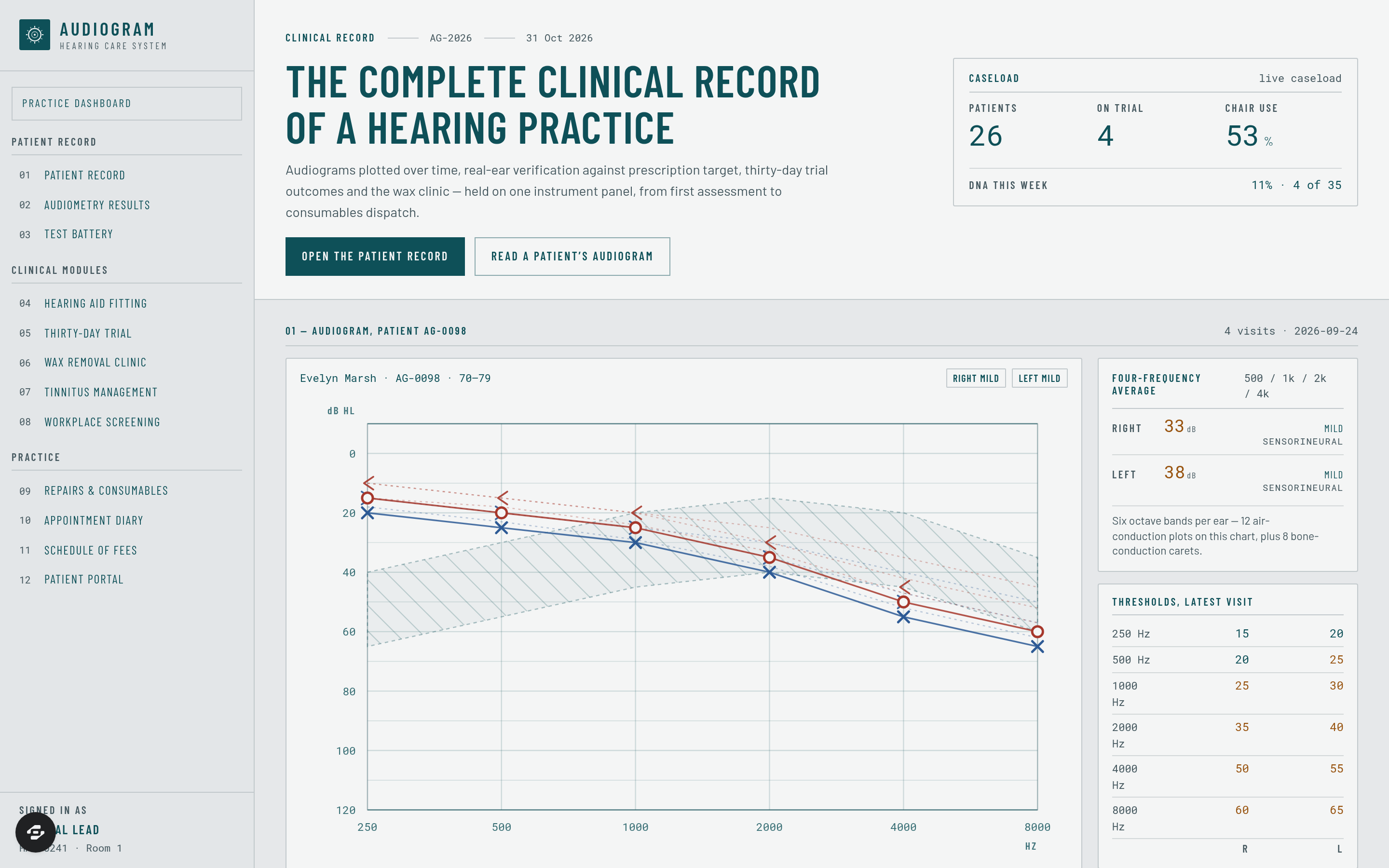
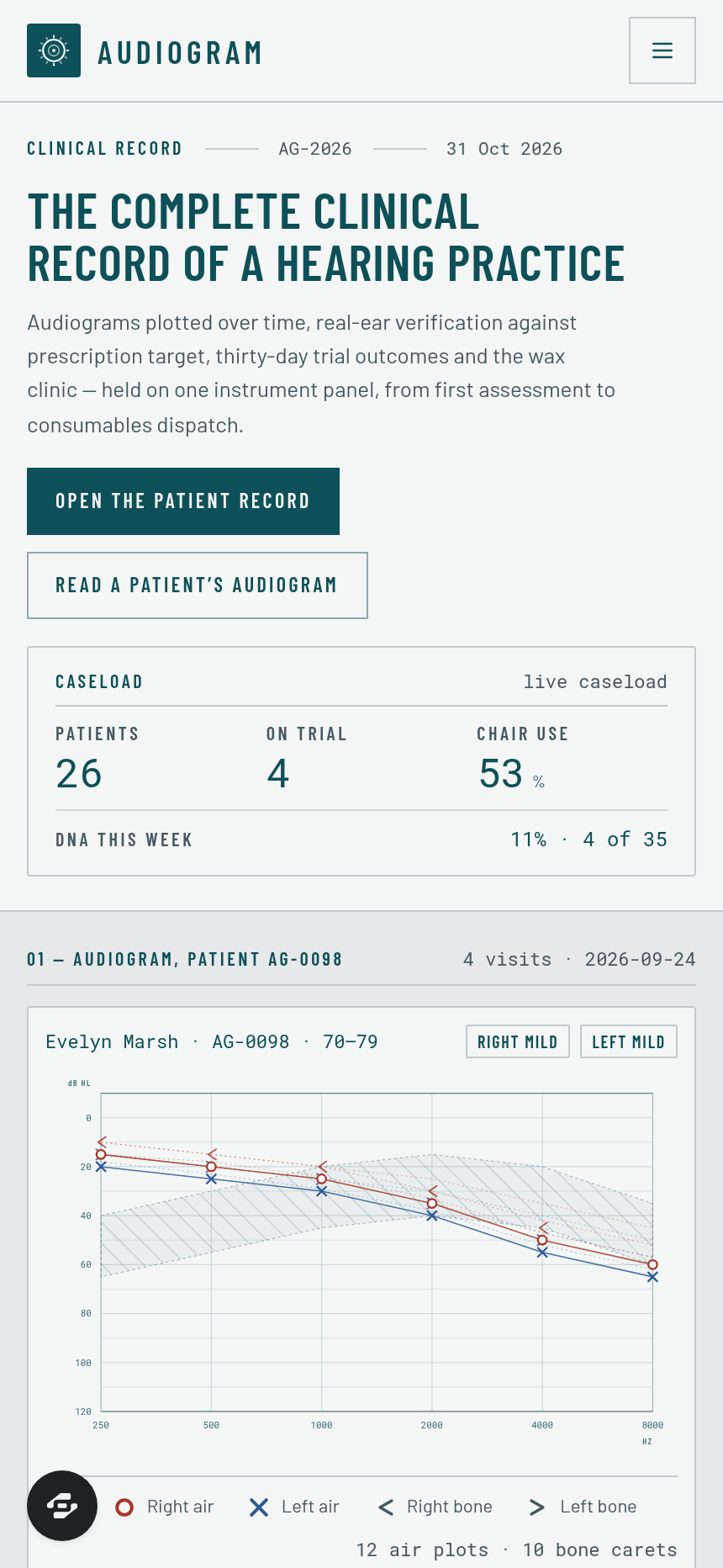
The complete clinical and commercial system of an independent audiology and hearing care practice: the practice that tests hearing, fits and verifies hearing aids, removes wax, runs a tinnitus programme and screens workplace noise exposure. The authority on what each patient can hear, what was fitted, whether it met target, and what it costs. The signature Audiometry module is the audiogram itself, drawn to standard as a real chart - frequency on a logarithmic axis from 250 to 8000 Hz, hearing level on an inverted axis from -10 to 120 dB HL, the standard grid, red circles for the right ear and blue crosses for the left, bone-conduction carets, and the speech banana shaded as a true hatched region - with twelve air-conduction plots and eight bone-conduction carets countable from the drawing, the four-frequency average computed beside it, and the configuration and type stated as MILD through PROFOUND and SENSORINEURAL, CONDUCTIVE or MIXED.
Behind it: a patient record with referral source, presenting complaint, otoscopy findings per ear and care-pathway stage; a test battery recording pure tone audiometry, tympanometry with its peak compliance and ear canal volume, acoustic reflex thresholds, speech discrimination as a percentage at a stated presentation level and otoacoustic emissions pass or refer per band, each against the calibration date of the instrument it was run on; hearing aid fitting with make, model, style from receiver-in-canal to completely-in-canal, receiver power, dome or mould, the prescription target used and a REAL EAR MEASUREMENT overlay plotting measured output against target with the deviation in decibels at each frequency; a thirty-day trial carrying datalogged daily wear hours, every fine-tuning adjustment made at follow-up, the patient-reported benefit score and the outcome PURCHASED, EXTENDED or RETURNED with its reason; a wax removal clinic recording microsuction, irrigation or curettage, occlusion grade before and after, contraindications screened and the outcome CLEAR, PARTIAL or REFERRED TO ENT; tinnitus management with the handicap inventory score at intake and each review, the pitch and loudness match, the management used and the score change achieved; workplace noise screening with each employer contract's daily personal noise exposure measured against the action levels, the cohort categorisation and the employees requiring referral; repairs and consumables with fault, turnaround days, warranty status and the subscription dispatch; an appointment diary by room and clinician with appointment durations, chair utilisation against capacity and the did-not-attend rate; and a schedule of fees covering assessment, wax removal per ear, hearing aids by technology level, the aftercare years included, the tinnitus block and workplace screening per employee. Patients get a portal that plots their own audiogram across every visit and explains it in plain language, with their device settings history, wear time logged, next appointment and consumables dispatch. Drawn entirely in the idiom of a 1960s-70s high-fidelity equipment brochure crossed with Ulm School clinical modernism: a cool pale aluminium ground carrying a brushed hairline texture drawn as fine parallel strokes, deep instrument teal as the primary ink, a warm signal amber used strictly and only for a threshold outside normal limits, a failed target deviation, an overdue repair or an exposure over the action level, knurled rotary controls drawn as stroked concentric rings with radial ticks, engraved small-caps panel legends and tabular numerals throughout.
Both fold figures close as exact partitions of their stated totals. Zero photography, zero raster imagery, zero gradients - the audiogram, the real-ear overlay, the tympanogram trace and every control motif are hand-drawn inline SVG.
Frequently asked questions
What is the Audiogram template?
How long does it take to build an app with the Audiogram template?
Do I need to code to use the Audiogram template?
How much does the Audiogram template cost?
Can I customize the Audiogram template?
Review current pricing and the template inspection guide before you start.
Related templates
 Health
Careline
Run your agency with calm, connected care.
 Health
Ignite
Boutique HIIT studio class booking, packs, and a member dashboard.
 Health
Recoverline
Every exercise done. Every milestone marked.
 Health
Sprout
Illustrated nutrition coaching booking — whole food, hand-grown
Make this template your starting point.
Inspect the preview, plan your changes, and test the workflow before you share it.
Use this template