

Remix when a template already matches your core workflow and permission model. Start from a brief when it would take more work to remove assumptions than to describe the app you need. Judge the starting point by how it works, not just its screenshot.
A real starting point · Ledgerline
Follow one record before you remix.
Ledgerline is a useful starting point for a partner portal because a commission has a date, owner, amount, and status. Those relationships matter more than the placement of the cards.
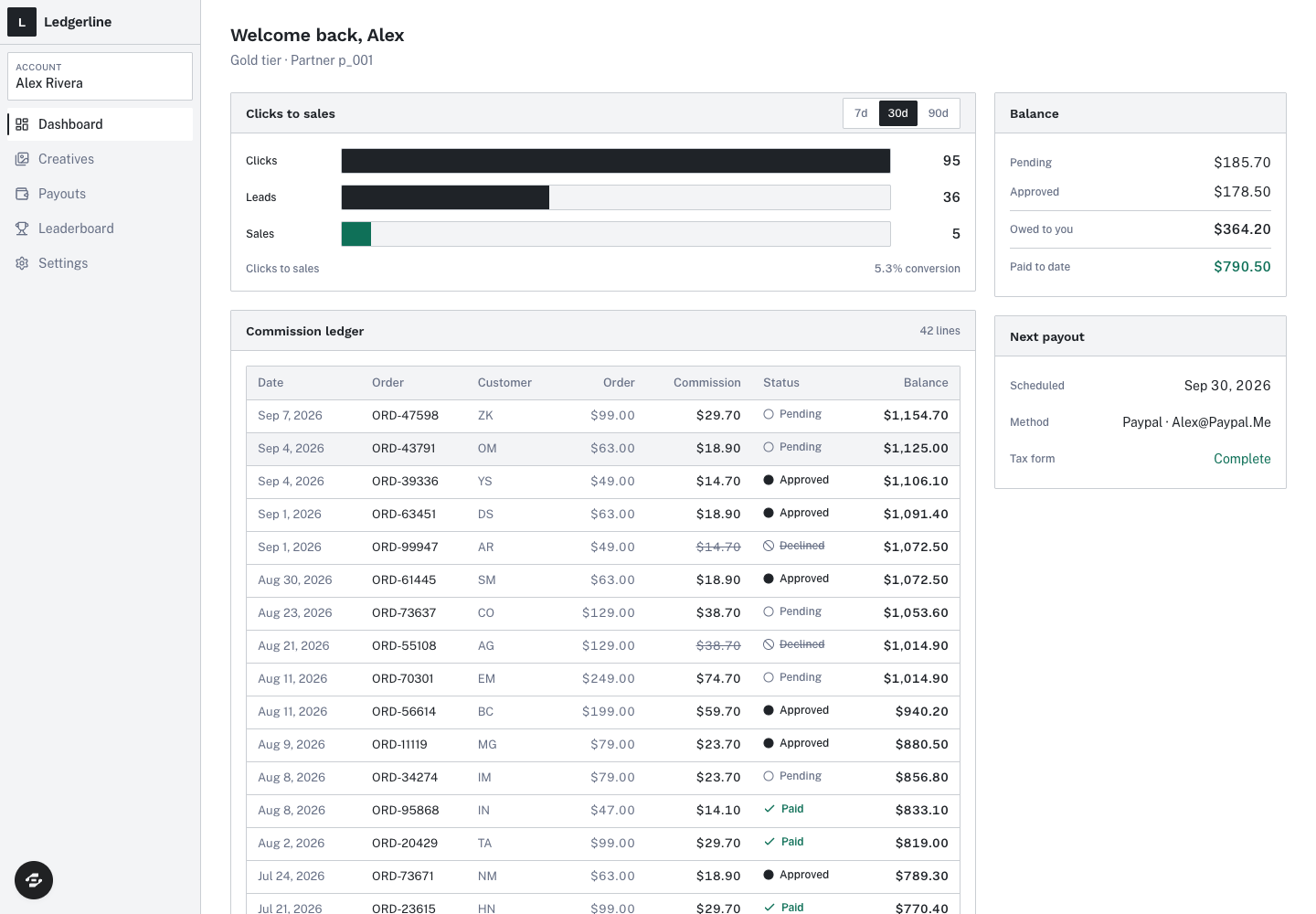
Ledgerline’s partner demo puts the commission ledger beside the balance and next payout. Seeded commissions and balances are stored in this browser; they are sample data, not real payouts.
Preview captured · Open live preview · View full-size imageWhat to inspect
- Follow a recordConnect one ledger row to its date, order, commission, and status. Decide which of those fields your workflow needs.
- Keep useful distinctionsPending, approved, declined, and paid have different meanings. The demo pairs each label with a symbol.
- Plan the real connectionsBefore launch, implement and test server storage, partner permissions, attribution, and your payout service.
In the preview, choose ‘Continue as Partner’ for sample data. Creating your own copy continues through signup or sign-in, with account access and credits to check first. Current plans and credits.
What does remixing an app mean?
A remix starts a new app from an existing template or an app that its creator has made available to remix. You then adapt the copy, design, data, and behavior for your own use. It is a starting point, not evidence that the result is ready for your customers.
Browse the Overskill template library and open the detail page for a candidate. Check its description, preview, and any purchase or access requirements before continuing. A public app is not automatically remixable, and templates can have different terms. Follow the template's actual call to action rather than constructing a remix URL yourself.
For a different starting point, inspect Bookslot’s appointment-booking template and its remix page. Its service-and-time-slot flow suits a local service business; Ledgerline’s commission ledger suits an affiliate operator. Similar layouts would not make their underlying records interchangeable.
Compare the work, not the screenshot
Scroll horizontally to compare all columns.
| Decision | Remix is a good starting point when… | Start from a brief when… |
|---|---|---|
| Core journey | The main action already resembles yours | The template optimizes for a different action |
| Data | Most records and relationships fit | You would replace the underlying model |
| Permissions | The same roles and privacy boundaries apply | A public template needs a private multi-client structure |
| Integrations | Its connected-service assumptions suit you | Its main workflow depends on a service you do not use |
| Presentation | You mainly need branding and content changes | The interaction pattern itself needs to change |
A habit tracker can be an excellent starting point for another personal tracker. It is a less obvious starting point for a coaching portal with clients, coaches, assignments, and restricted notes. Similar-looking cards do not mean similar permissions.
Inspect a template in five passes
- Complete its main journey. Identify what someone can finish, not merely what is pictured. If a live preview is unavailable, mark the behavior unverified.
- List the records. Note which data belongs to a user, a team, or everyone. Compare that list with your app brief.
- Check the edge cases. Look for empty lists, failed submissions, long names, and phone layouts. These reveal how much finishing work remains.
- Identify dependencies. Write down external services, secrets, payment setup, and any data you must supply. Do not assume a creator's connection or account transfers to you.
- Read the terms and cost. Review the template detail, access requirements, and current Overskill pricing. Separate acquiring the template from building and operating your customized app.
If you cannot establish an important detail, make it a question for the first build pass. Uncertainty is useful information; it should not disappear when you click the call to action.
A remix prompt that preserves what works
Adapt this starting app into a client request portal for a design studio.

Keep: the working request list, mobile navigation, and status filters.
Change: copy and visual identity to suit a small design studio.
Add: a client workspace on each request and agency/client access roles.
Remove: sample people, sample email addresses, and unrelated checkout UI.

Before changing behavior, explain the existing records and permissions.
Do not reuse another creator's credentials, accounts, or customer data.
Do not send email or charge a payment during setup.
Afterward, give me a test using two clients in separate workspaces.
This prompt describes a requested adaptation. Review the actual implementation and connections before using real information. For a private portal, the permission change is a substantive backend task even if the visual change looks small.
When starting fresh is the simpler choice
Start with a new brief if the app's main value depends on unusual rules: a complex approval chain, a specialized inventory model, or a particular ownership boundary. You can still borrow a visual idea without inheriting the entire workflow.
Make the first version deliberately narrow. Build the primary action, inspect saved data, test access, and then add the next step. A fresh app with a clear scope is often easier to reason about than a heavily modified template whose old behavior is still scattered through the interface.
Your remix is ready when the journey is proven
Use your own sample data and accounts. Complete the core journey after refreshing and on a phone. Check that links, messages, legal copy, and brand assets describe your app. Record every dependency that remains unconfigured.
Then follow the launch checklist, or use the client portal build guide for a concrete example. The right template saves useful work; your acceptance tests tell you how much work remains.