

Autoclave
Autoclave is the complete working system of a hospital sterile services department - the basement unit that receives every contaminated surgical instrument tray back from theatre, washes it, inspects it, reassembles it against its own authored contents list, sterilises it...
About this template
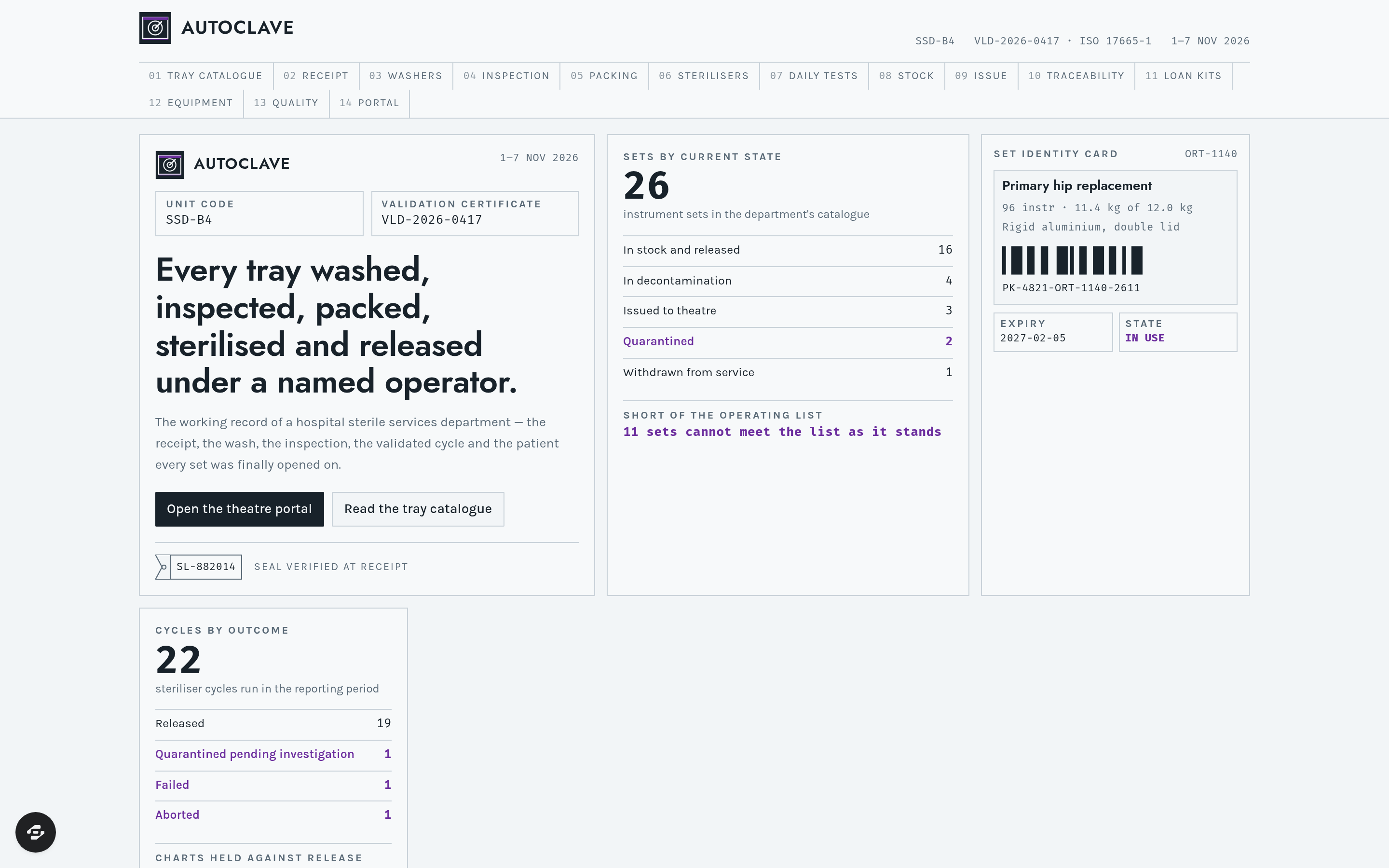
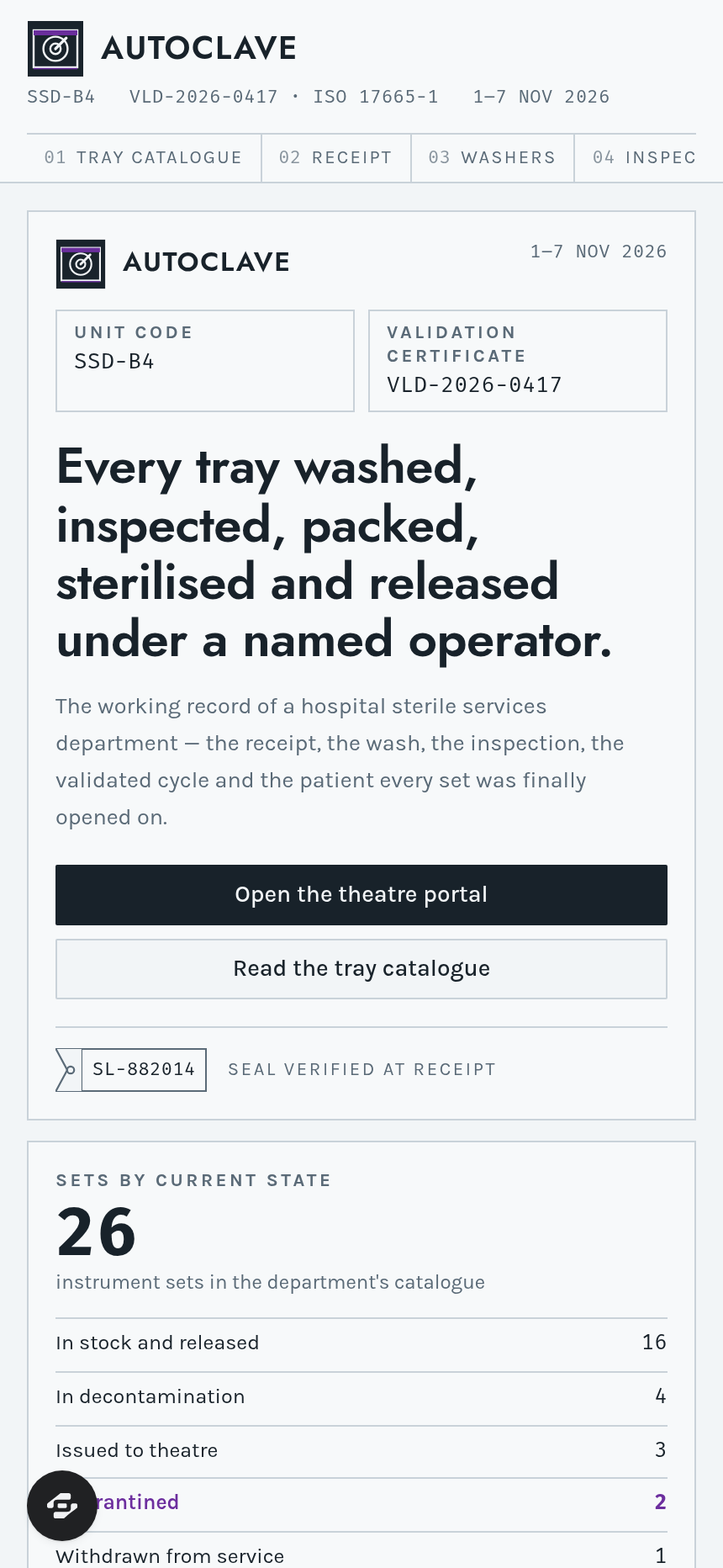
Autoclave is the complete working system of a hospital sterile services department - the basement unit that receives every contaminated surgical instrument tray back from theatre, washes it, inspects it, reassembles it against its own authored contents list, sterilises it under a validated cycle, and returns it to the shelf traceable to the patient it will next be opened on. It tracks every tray and loan kit through decontamination, runs the washer-disinfectors and records their cycle parameters, counts each instrument against its tray list, holds every steriliser cycle's chart until a named operator releases it, tests the machines each morning with their physical, chemical and biological indicators, issues sets to theatre against the day's operating list, and reports the department's performance to the infection-control committee.
Fourteen real modules, each a browsable page with real seeded data. The TRAY AND SET CATALOGUE carries each set's contents count, its assembled weight against the handling limit, its container and filter type, the copies held against the copies available, and the contracted turnaround. DECONTAMINATION RECEIPT records the transport seal number, whether a set arrived wet or with sharps loose, and the delay between use and reprocessing against the recommended maximum. WASHER-DISINFECTOR CYCLES holds each stage's temperature and hold time, the A0 value achieved against the A0 required, the detergent dose and batch, and the final rinse water's conductivity and endotoxin result.
INSPECTION AND REPAIR works instrument by instrument through function, alignment, insulation and bio-burden under magnification. PACKING AND LABELLING shows the contents counted against the list, the internal chemical indicator placed, the tamper-evident seal serial and the packer's own competency expiry. STERILISER CYCLES AND RELEASE carries the hold time achieved against the band required, the pre-vacuum pulse count, the leak rate and the parametric release decision by a named operator. The DAILY TEST RECORD with its Bowie-Dick and biological indicators, STOCK AND SHELF LIFE, THEATRE ISSUE AND RETURN against the operating list, PATIENT TRACEABILITY with its recall exposure computed across every case a faulty cycle touched, the LOAN KIT REGISTER, EQUIPMENT SERVICE AND VALIDATION, and QUALITY AND INCIDENTS complete the department's view. A THEATRE PORTAL gives a theatre team its own sets, loans and expiries, and a STERILE SERVICES DASHBOARD closes the loop.
The signature drawing is the steriliser cycle chart: one validated porous-load cycle drawn on a fine minor grid and a heavier major grid, elapsed time ruled in minutes and chamber temperature in degrees with both axes labelled at their terminal ends, the chamber temperature and the chamber pressure drawn as two continuous traces each named at its own terminal point, the sterilisation hold band drawn as a tolerance corridor bounded by dashed rules, each pre-vacuum pulse marked with a numbered event tick dropped to the time axis, and the achieved hold time stated on a chip between the hold's start and end - the whole plate headed by a printed chart header block naming the machine, the cycle, the programme and the releasing operator. Designed as a clinical instrument-tray docket crossed with a 1980s chart-recorder trace printout: a cold instrument white ground, slate ink, steel-grey grid lines, boxed small-caps field captions and drawn barcode blocks, and a single indicator violet reserved strictly for a set short of the operating list, a failed or aborted wash, a quarantined steriliser cycle, a machine used before its daily tests were complete, a pack inside seven days of expiry, a traceability chain missing a link or a corrective action overdue.
Frequently asked questions
What is the Autoclave template?
How long does it take to build an app with the Autoclave template?
Do I need to code to use the Autoclave template?
How much does the Autoclave template cost?
Can I customize the Autoclave template?
Review current pricing and the template inspection guide before you start.
Related templates
 Health
Careline
Run your agency with calm, connected care.
 Health
Recoverline
Every exercise done. Every milestone marked.
 Health
Ignite
Boutique HIIT studio class booking, packs, and a member dashboard.
 Health
Sundial
Med-spa & aesthetics booking with a membership glow-club.
Make this template your starting point.
Inspect the preview, plan your changes, and test the workflow before you share it.
Use this template