

Bitting
Bitting is the locksmith shop's record for an estate that runs a master-key system: a university, a hospital, a council, a large campus.
About this template
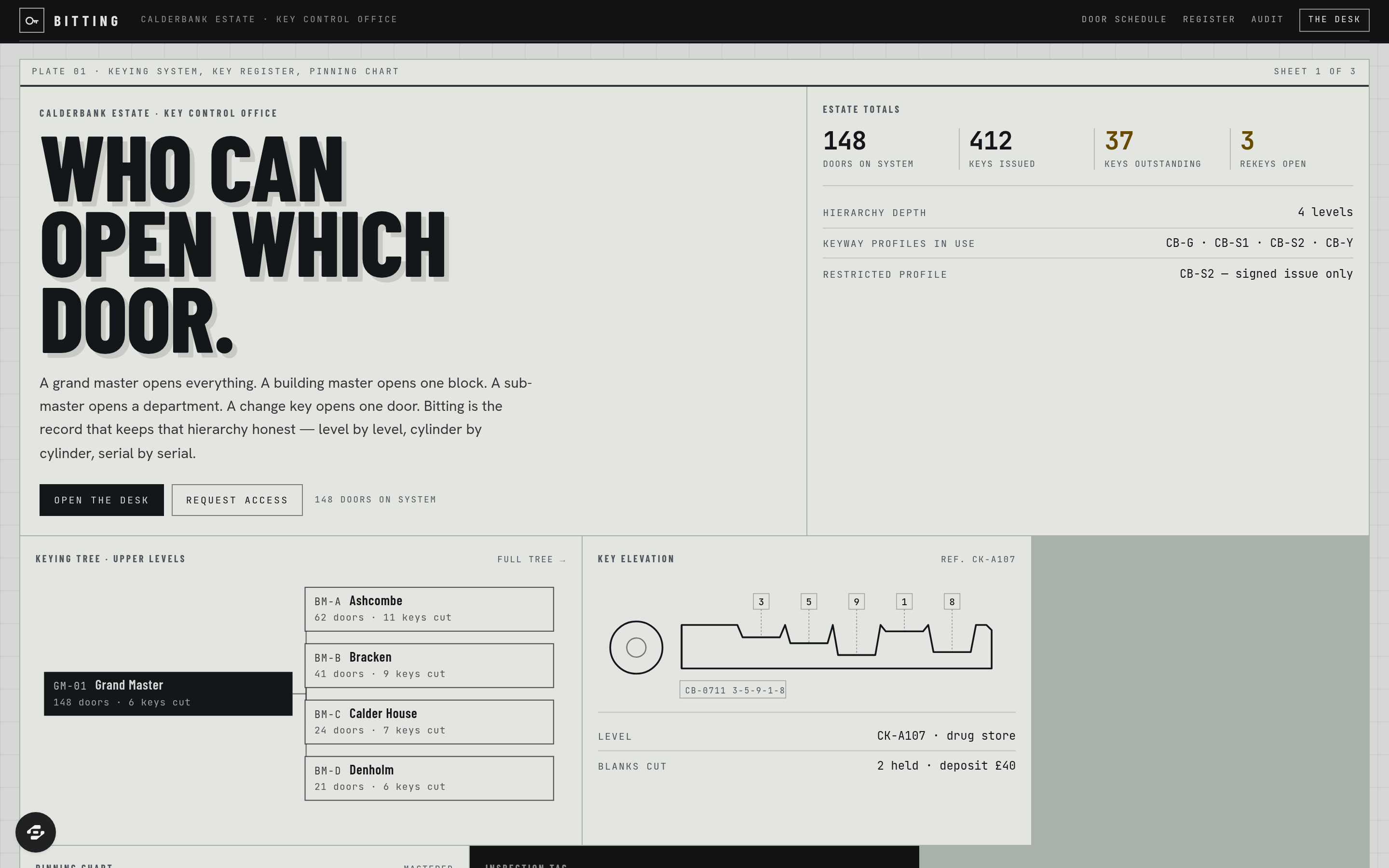
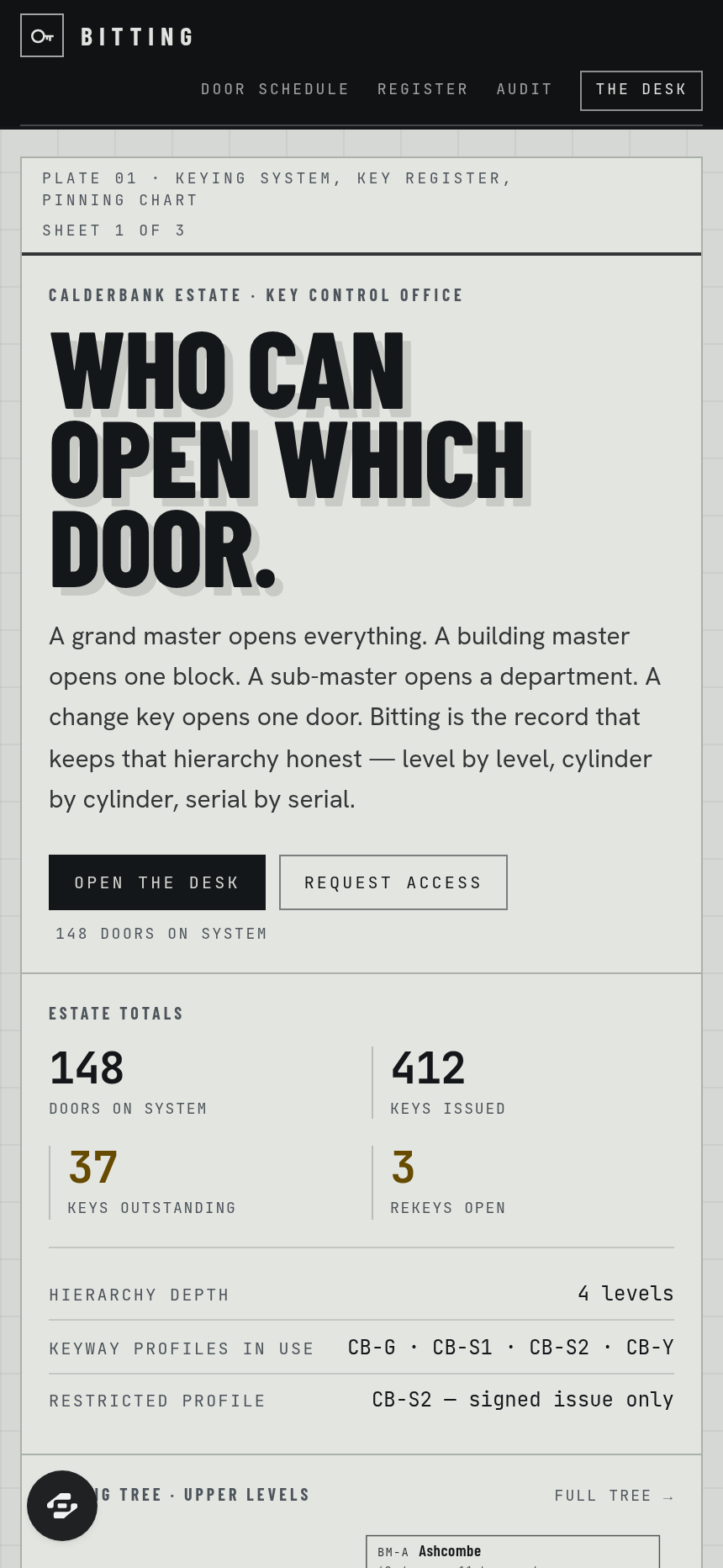
Bitting is the locksmith shop's record for an estate that runs a master-key system: a university, a hospital, a council, a large campus. A grand master opens everything, a building master opens one block, a sub-master opens a department, a change key opens one door — and the hierarchy only means anything if somebody holds the authoritative record of it.
The keying system screen draws that hierarchy from the grand master down, showing how many doors and how many cut keys sit at each level. Underneath it the door schedule names every lock on the estate with its building, door number, function, keyway profile, cylinder type and length, and the key register tracks every cut key by serial — its bitting, the level it belongs to, who is holding it and since when. The issue desk records a key handed to a named person with deposit, signature and expected return, and keeps the overdue list honest.
The screens that earn their keep are the ones for the bad days. A pinning chart lays out a specific cylinder's pin stacks with bottom and driver depths and the master wafers, plus the keys that must and must not operate it, in a form a locksmith can work from at the bench. A rekey order raised against a lost key says exactly which doors are compromised, which cylinders must be repinned, how many keys must be recut and what it costs. An expansion test asks whether a proposed new door can be keyed into an existing level without a cross-key conflict and says plainly when it cannot — the question that quietly destroys a keying system when nobody asks it. An audit answers "who can open this door today" and "what can this person open", with the evidence behind both.
It is drawn as a mid-century industrial hardware catalogue rather than a dashboard: dense catalogue plates with stock codes and hairline rules, stencilled plate headers under hard offset shadows, orthographic line-drawn keys with their bitting called out along the blade, and tabular figures for every depth, serial and door number. It suits anyone who holds mechanical keys for other people: estates and facilities teams, universities and schools, hospitals and care groups, social landlords, locksmiths and master-key dealers, and the key-control office of any multi-building site.
Frequently asked questions
What is the Bitting template?
How long does it take to build an app with the Bitting template?
Do I need to code to use the Bitting template?
How much does the Bitting template cost?
Can I customize the Bitting template?
Review current pricing and the template inspection guide before you start.
Related templates
 Productivity
Synapse
A networked second brain for writers, researchers & founders.
 Productivity
Momentum
Ninety days. One clear target. Every day counts.
 Productivity
Satchel
Every client, onboarded without the chase.
 Productivity
Clockwork
Every hour, accounted for.
Make this template your starting point.
Inspect the preview, plan your changes, and test the workflow before you share it.
Use this template