

Culvert
Culvert is the service that keeps the road from flooding.
About this template
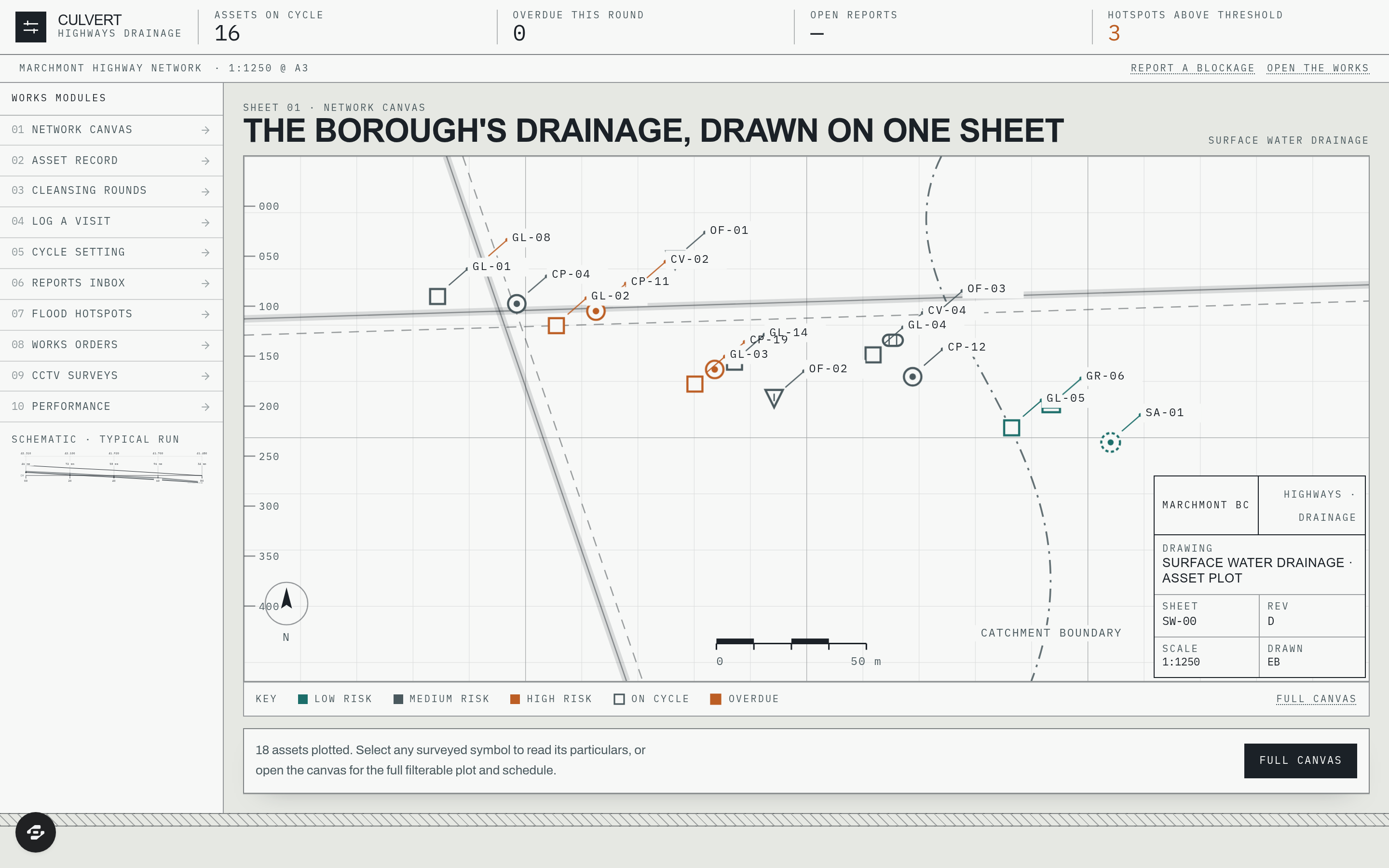
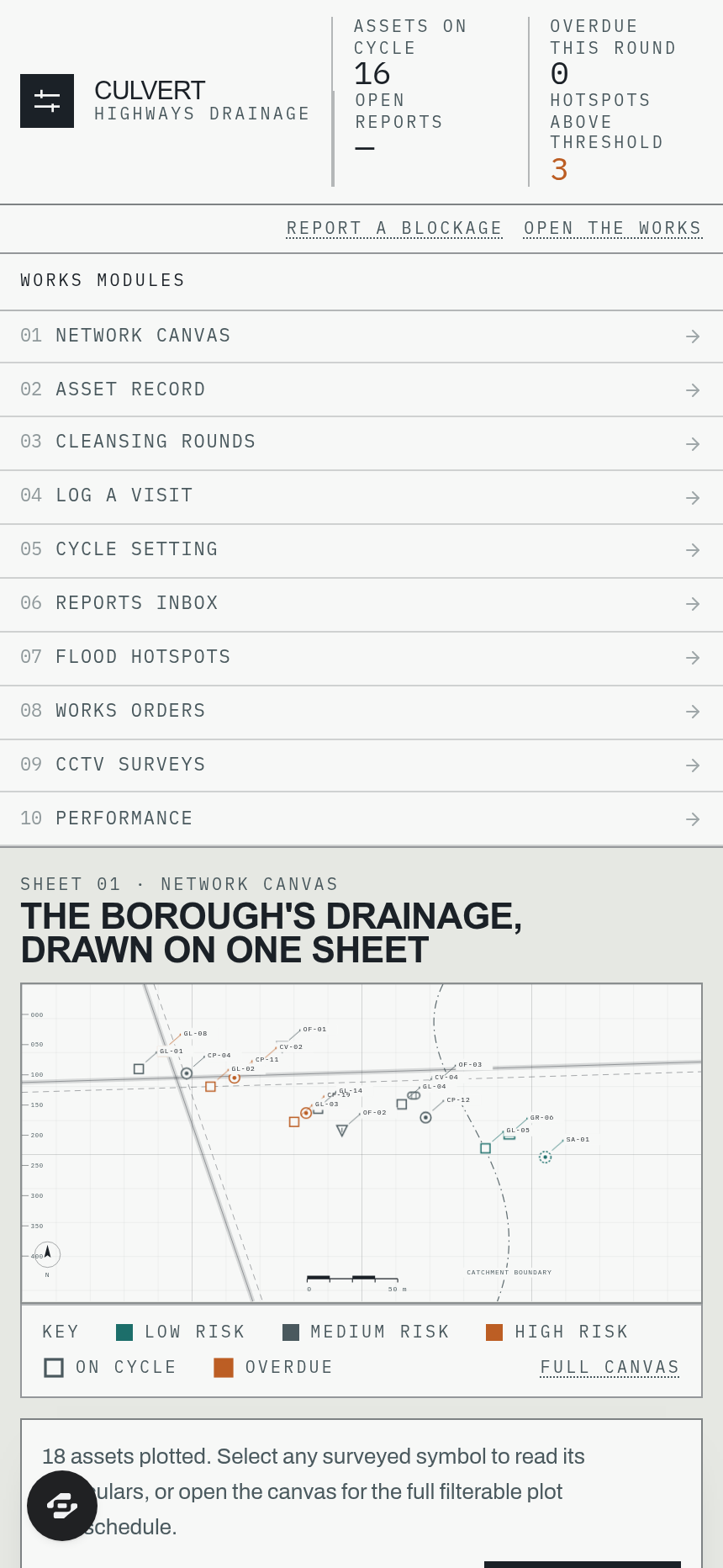
Culvert is the service that keeps the road from flooding. It holds every drainage asset on a borough's highway network — gullies, grids, catchpits, culverts, soakaways and outfalls — with its grid reference, construction, depth, gradient and the whole history of what has been pulled out of it.
The idea underneath it is that a flat annual sweep is the wrong schedule. One gully under a line of plane trees silts up three times a year; another has not needed touching since it was laid. The cycle-setting screen proposes a per-asset interval from that asset's own silting history and shows immediately what the proposal does to a round's workload, so the argument about frequency is had with measurements rather than habit. Rounds are then planned as an ordered run with travel order, crew and tanker capacity, and the crew records each visit with silt depth before and after, what came out, whether the asset was even reachable, and a photograph.
The rest is what happens when it goes wrong. A reports inbox triages blockage and standing-water reports from the public, deduplicates them against an asset and promotes one to a job. A hotspot screen ranks locations by consequence and by how overdue the contributing assets are, with the drawn long-section of the run underneath. Works orders carry jetting, CCTV survey and reconstruction with quotes and scheduled windows, CCTV surveys record defect codes along a chainage, and a performance screen charts assets cleansed per round, mean silt depth by catchment and the places that block again and again.
It is drawn as an engineer's survey sheet rather than a dashboard: a title block in the corner, hatched ground sections, chainage ticks and invert levels annotated with leader lines, a north point and a scale bar, with the long-section — crown, invert and a measured silt line — used both as the product's survey screen and as the graphic device throughout. It fits any organisation that maintains a dispersed network of physical assets on a cycle: highway and lead local flood authorities, water and wastewater companies, drainage contractors, canal and harbour trusts, airport and port estates, and large private estates or campuses.
Frequently asked questions
What is the Culvert template?
How long does it take to build an app with the Culvert template?
Do I need to code to use the Culvert template?
How much does the Culvert template cost?
Can I customize the Culvert template?
Review current pricing and the template inspection guide before you start.
Related templates
 Utilities
Homestead
Never miss a filter, a flush, or a fall cleanup.
 Utilities
Sundry
Every possession, catalogued and covered.
 Utilities
Voltworks
Quote it. Weld it. Get paid. Run your whole shop like a shop drawing.
 Utilities
Toolbelt
Run the whole day from one board.
Make this template your starting point.
Inspect the preview, plan your changes, and test the workflow before you share it.
Use this template