

Repeater
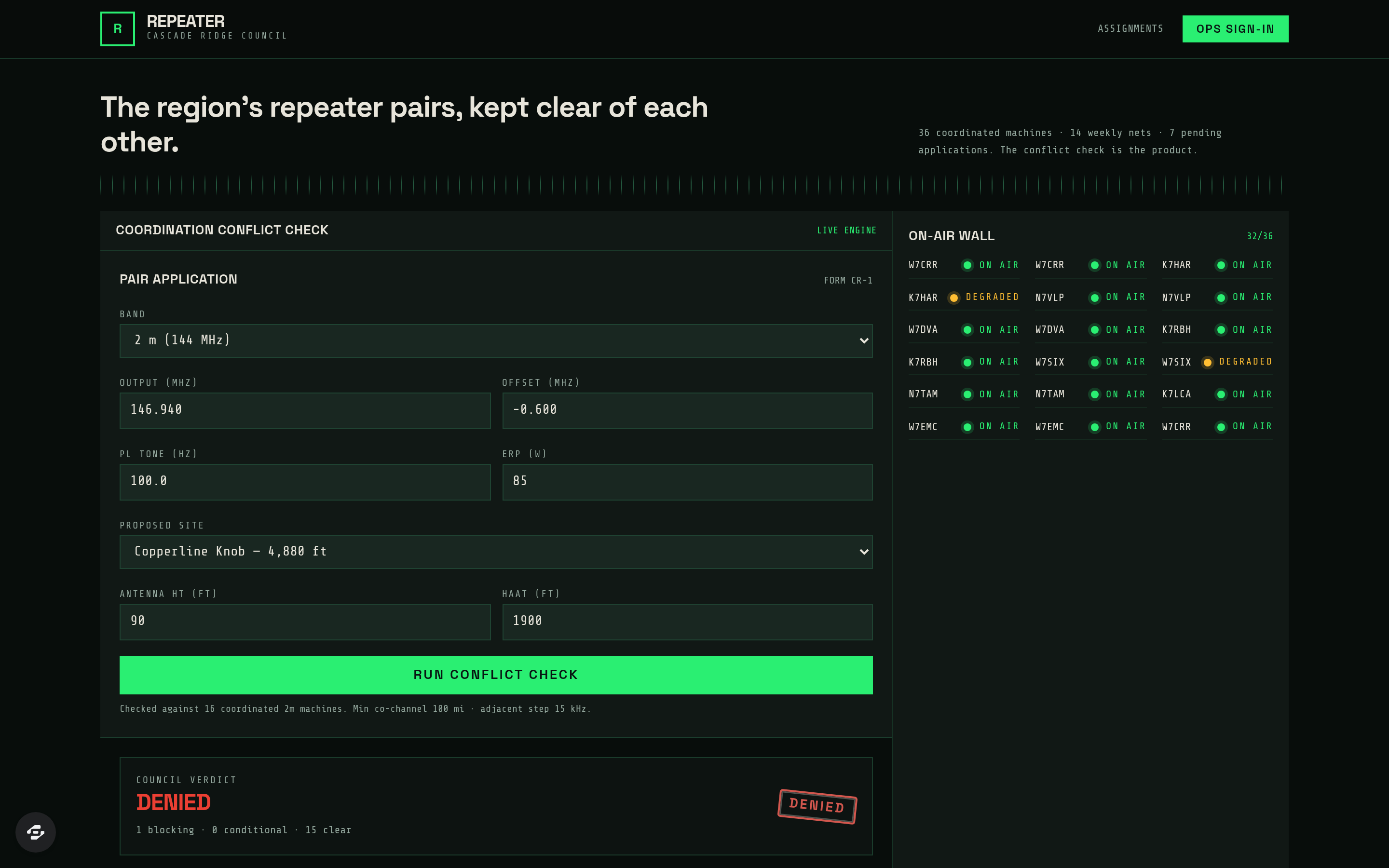
Repeater is the coordination desk for an amateur-radio repeater council: the volunteer body that decides which frequency pairs a region's machines may use, so that thirty-six repeaters on shared bands do not sit on top of each other. The product is the conflict check.
About this template
Repeater is the coordination desk for an amateur-radio repeater council: the volunteer body that decides which frequency pairs a region's machines may use, so that thirty-six repeaters on shared bands do not sit on top of each other.
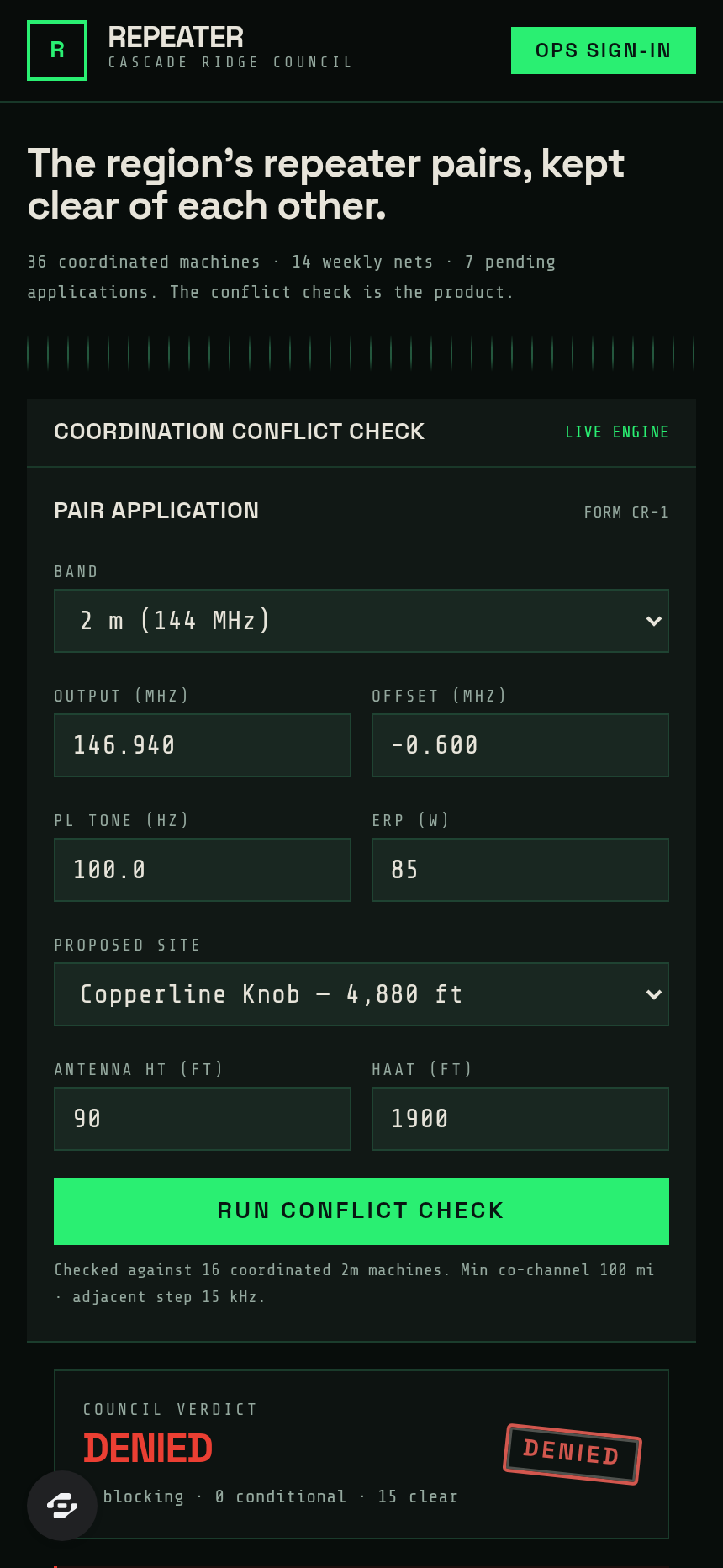
The product is the conflict check. An applicant proposes a pair — band, output frequency, offset, PL/CTCSS tone, ERP, site, antenna height and HAAT — and the engine computes, against every coordinated machine on that band, the frequency separation in kHz and the great-circle distance in miles between the two sites. Each pairing is classified CO-CHANNEL, ADJACENT, OFFSET or CLEAR against the band's own rules (channel step, minimum co-channel mileage), and the whole set rolls up into one verdict: COORDINATED, CONDITIONAL or DENIED, with every blocking machine named and its reason spelled out. When an application is denied, the engine scans the band plan outward on channel steps and suggests the nearest frequency that would clear.
Around that sit the council's live records. The on-air annunciator wall shows all thirty-six machines by callsign and state — on air, degraded, off air. The request queue tracks pending applications against a thirty-day SLA with assigned reviewers. Mountaintop and water-tower sites carry their elevation, HAAT and coverage contours. The net schedule ticker holds the region's weekly on-air nets with average check-ins. The outage log accrues downtime and yields a mean-time-to-repair figure. Linking topology, club rosters and the antenna and duplexer inventory round out the picture.
Styled as an instrument panel — phosphor green on near-black, monospaced figures, engraved hairlines and rubber-stamp verdicts — because the people using it are the same people who read a service monitor.
Built for frequency coordinators, repeater councils and spectrum committees. Remix it for a different band plan, a different region, or any resource that must be assigned without collisions.
Frequently asked questions
What is the Repeater template?
How long does it take to build an app with the Repeater template?
Do I need to code to use the Repeater template?
How much does the Repeater template cost?
Can I customize the Repeater template?
Review current pricing and the template inspection guide before you start.
Related templates
 Utilities
Homestead
Never miss a filter, a flush, or a fall cleanup.
 Utilities
Sundry
Every possession, catalogued and covered.
 Utilities
Voltworks
Quote it. Weld it. Get paid. Run your whole shop like a shop drawing.
 Utilities
Toolbelt
Run the whole day from one board.
Make this template your starting point.
Inspect the preview, plan your changes, and test the workflow before you share it.
Use this template