

Spanner
The complete working system of a volunteer-run community Library of Things: the lending library that loans carpet cleaners, SDS drills, pressure washers, sewing machines, gazebos, projectors, cake tins, wallpaper steamers and bike repair stands instead of books, for a small...
About this template
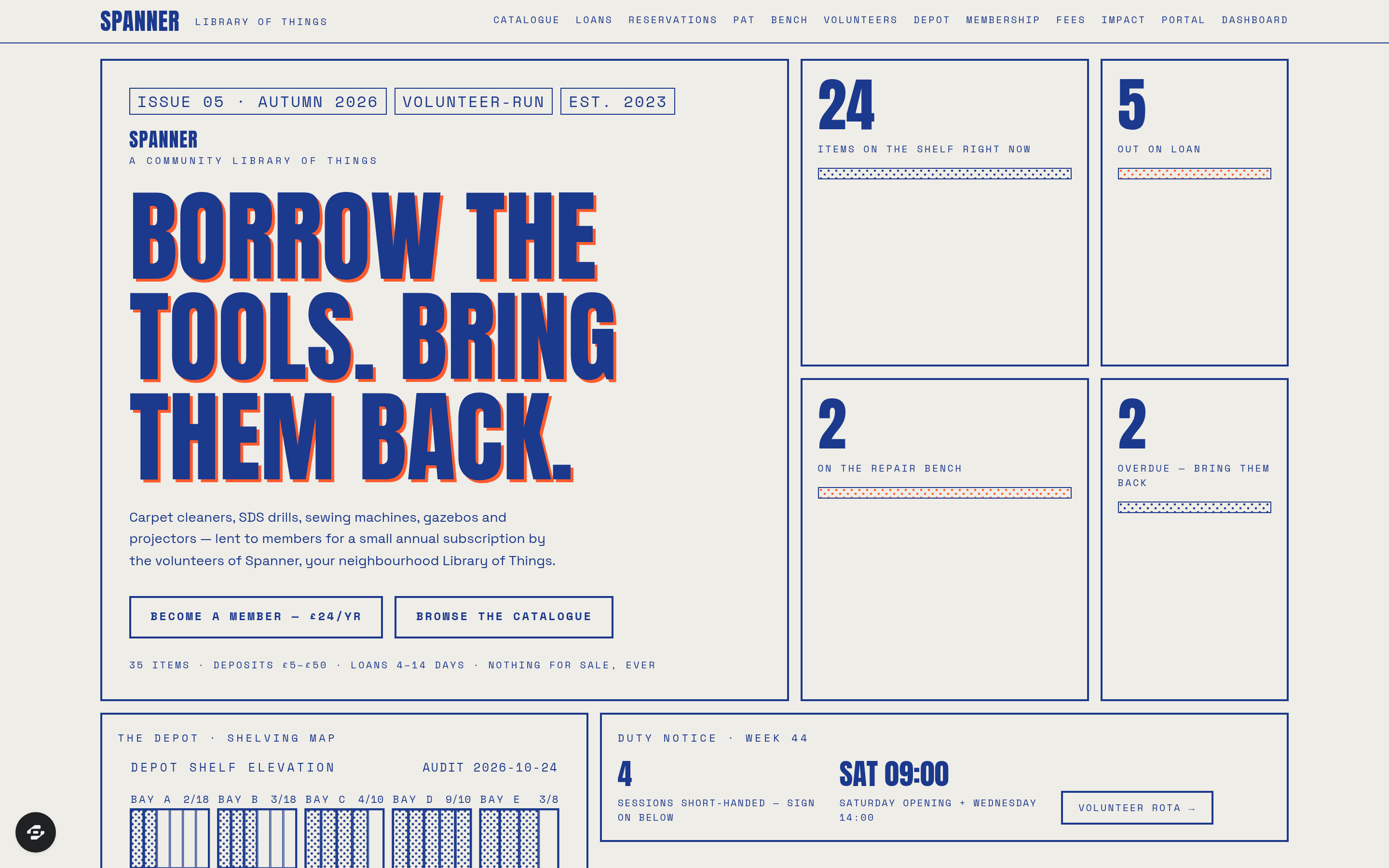
The complete working system of a volunteer-run community Library of Things: the lending library that loans carpet cleaners, SDS drills, pressure washers, sewing machines, gazebos, projectors, cake tins, wallpaper steamers and bike repair stands instead of books, for a small annual subscription, and gets every one of them back. The authority on what is on the shelf, what is out, what is safe to lend, and what is waiting on the bench. The signature Depot Shelf Elevation is the storeroom drawn as a real elevation in two riso inks - five racking bays, their levels and slots filled in halftone where occupied and outlined where empty, the heavy-item floor zone below with its pads named, and the linear metres used against capacity printed beneath, so the occupancy figure on the fold is countable from the drawing itself.
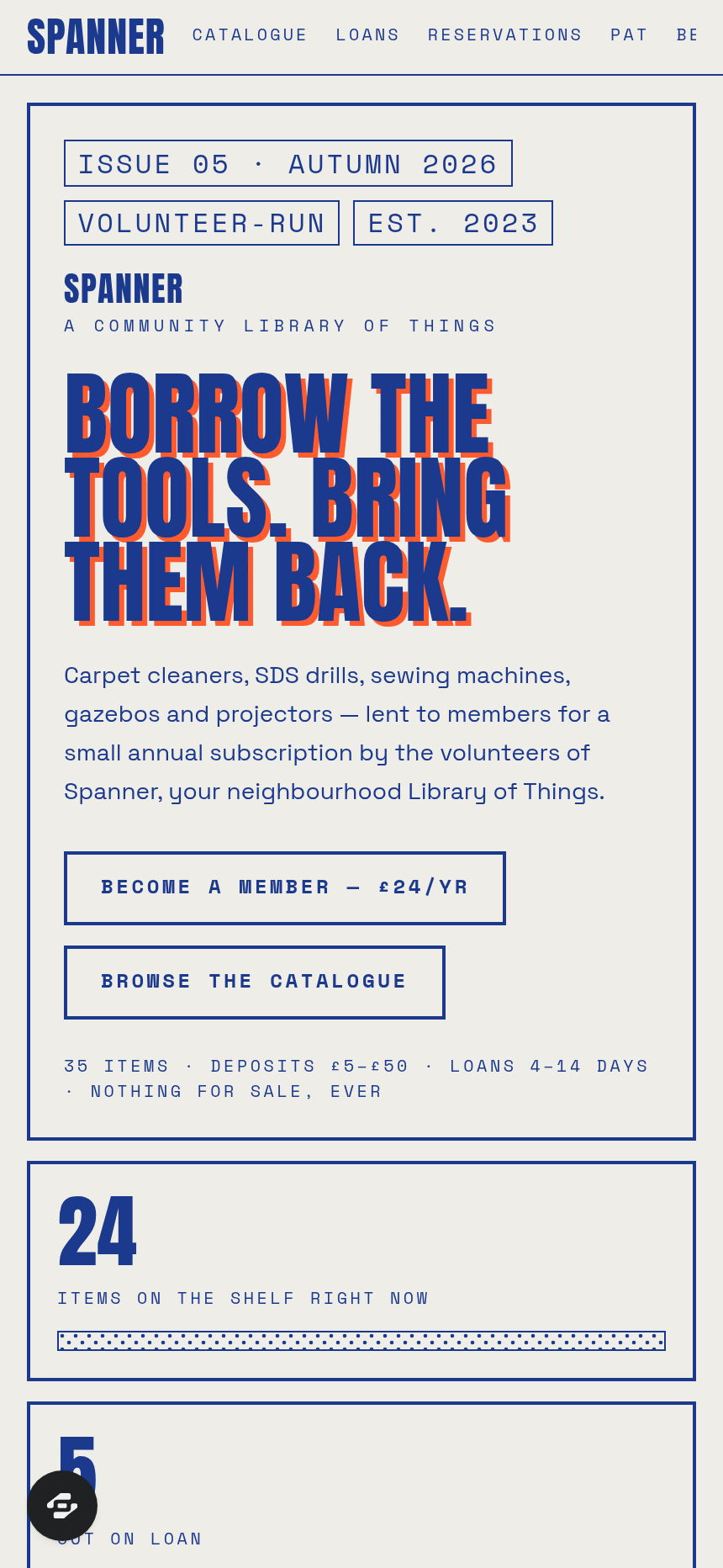
Behind it: an item catalogue carrying each item's number, category, manufacturer and model, the accessories that must come back with it enumerated line by line, replacement value, deposit band, loan period and condition grade from A EXCELLENT to D REPAIR ONLY, with status ON SHELF, ON LOAN, RESERVED, ON THE BENCH or RETIRED; a loan ledger with issue and due dates, days remaining or days overdue, the deposit held and the condition recorded both out and back; a reservation queue showing who is waiting for what, their position, the date the item is expected back and the collection window offered; a portable appliance testing register that is the safety spine of the whole library - test date, class I earthed or class II double insulated, earth continuity in ohms, insulation resistance in megohms, the tester and their certificate, the retest interval and the computed next-test date, with a failed item visibly blocking its own loan row; a repair bench carrying the fault reported, the diagnosis, parts ordered with part numbers and cost, volunteer hours logged and the outcome REPAIRED, PARTS AWAITED or BEYOND ECONOMIC REPAIR; a volunteer rota across the Saturday and Wednesday opening sessions with the skills each volunteer is checked out on and the sessions currently short-handed; membership tiers from concession to maker with their borrowing limits and deposit waivers; a schedule of fees covering subscription, refundable deposit bands, late return capped at the deposit, missing accessories and cleaning; and an impact record stating the purchases avoided, the money kept in members' pockets and the kilograms diverted from landfill by the bench, with the arithmetic printed beneath each figure. Members get their own portal - items out with days remaining, reservation positions, deposit held, renewal date and borrowing history - and the coordinator gets the board: on shelf against on loan, overdue with the oldest named, PAT tests due this month, bench backlog and short-handed sessions. Drawn entirely in the idiom of risograph zine and community print co-op duplicator printing: an uncoated newsprint ground, exactly two inks - riso federal blue and riso fluorescent orange - a deliberate three-pixel misregistration offset behind every headline, coarse halftone dot fills instead of flat tints, stamped condition badges, and chunky condensed grotesk set large and tight.
Both fold figures close as exact partitions of their stated totals. Zero photography, zero raster imagery, zero gradients - every pictogram, halftone band, shelf elevation and loan-cycle ring is hand-drawn inline SVG.
Frequently asked questions
What is the Spanner template?
How long does it take to build an app with the Spanner template?
Do I need to code to use the Spanner template?
How much does the Spanner template cost?
Can I customize the Spanner template?
Review current pricing and the template inspection guide before you start.
Related templates
 Utilities
Homestead
Never miss a filter, a flush, or a fall cleanup.
 Utilities
Sundry
Every possession, catalogued and covered.
 Utilities
Voltworks
Quote it. Weld it. Get paid. Run your whole shop like a shop drawing.
 Utilities
Toolbelt
Run the whole day from one board.
Make this template your starting point.
Inspect the preview, plan your changes, and test the workflow before you share it.
Use this template