

Whetstone
Whetstone sells kitchen knives from named makers and then takes them back in to sharpen them. Both halves of that live on the same site and on the same order: goods lines and service lines, one cart, one history per blade.
About this template
Whetstone sells kitchen knives from named makers and then takes them back in to sharpen them. Both halves of that live on the same site and on the same order: goods lines and service lines, one cart, one history per blade.
The shop is built on honest specification rather than adjectives. Every knife carries a hairline table — steel type, hardness, construction, blade length, spine thickness, weight, handle material, bevel symmetry — with a plain-language note on each row explaining what the number actually buys you, plus an SVG geometry diagram showing the grind profile and the bevel angle with its keys set outside the blade. A comparison view puts two or three knives side by side, spec row against spec row, which is the decision most knife buyers are really trying to make.
The sharpening side is a proper workshop system. A customer describes the blade and its damage — rolled edge, chip, tip break, rust — picks a service level and receives a job ticket with a quoted turnaround; the ticket then tracks the blade through received, assessed, ground, honed, polished, ready and shipped, carrying the assessor's notes and before-and-after measurements. Behind it, the shop gets a workshop queue by stage, due date and sharpener. Around both halves: a maker directory with workshop provenance, limited drops with quantity, waitlist position and allocation state, and a care library indexed by knife type and by stone grit.
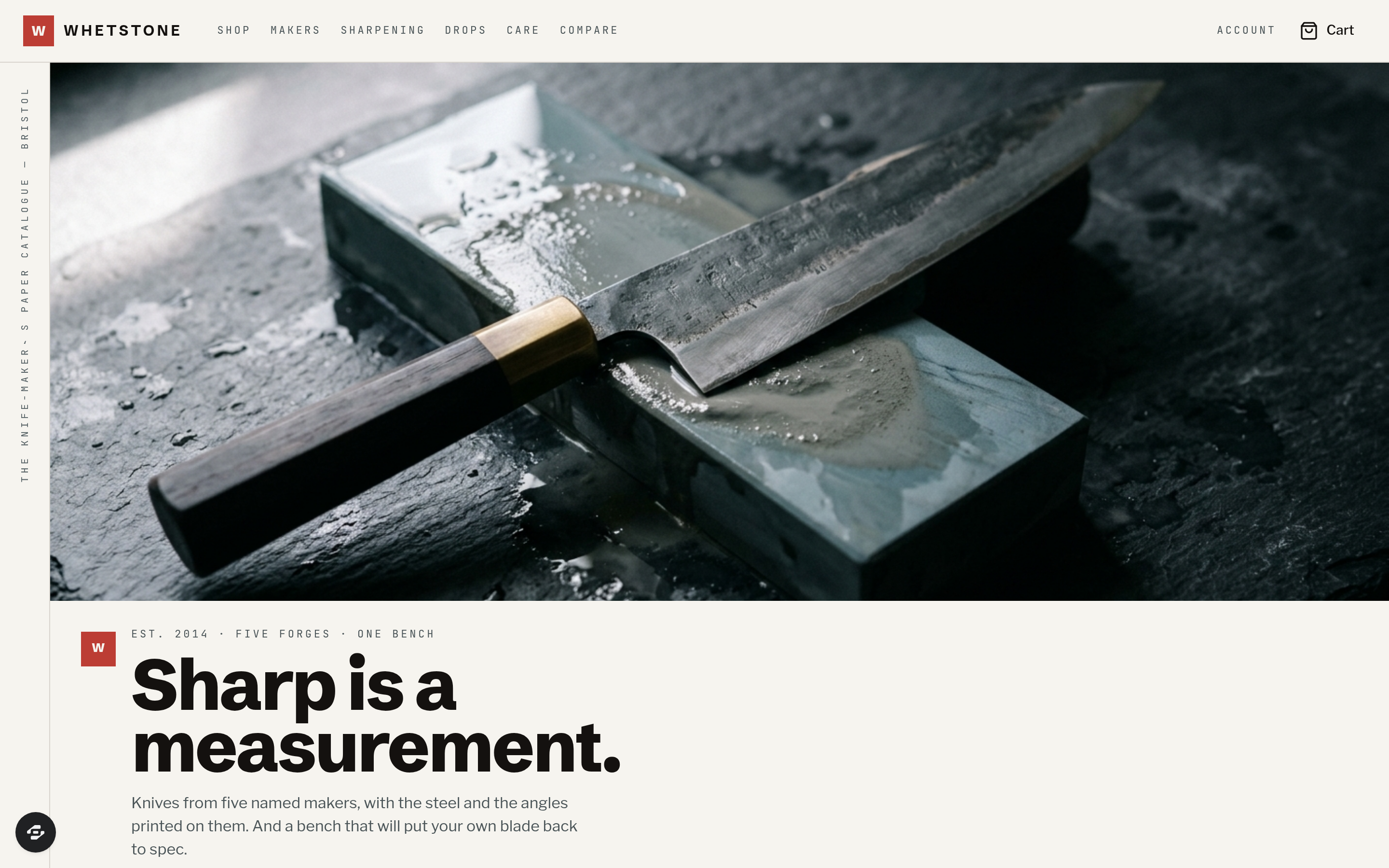
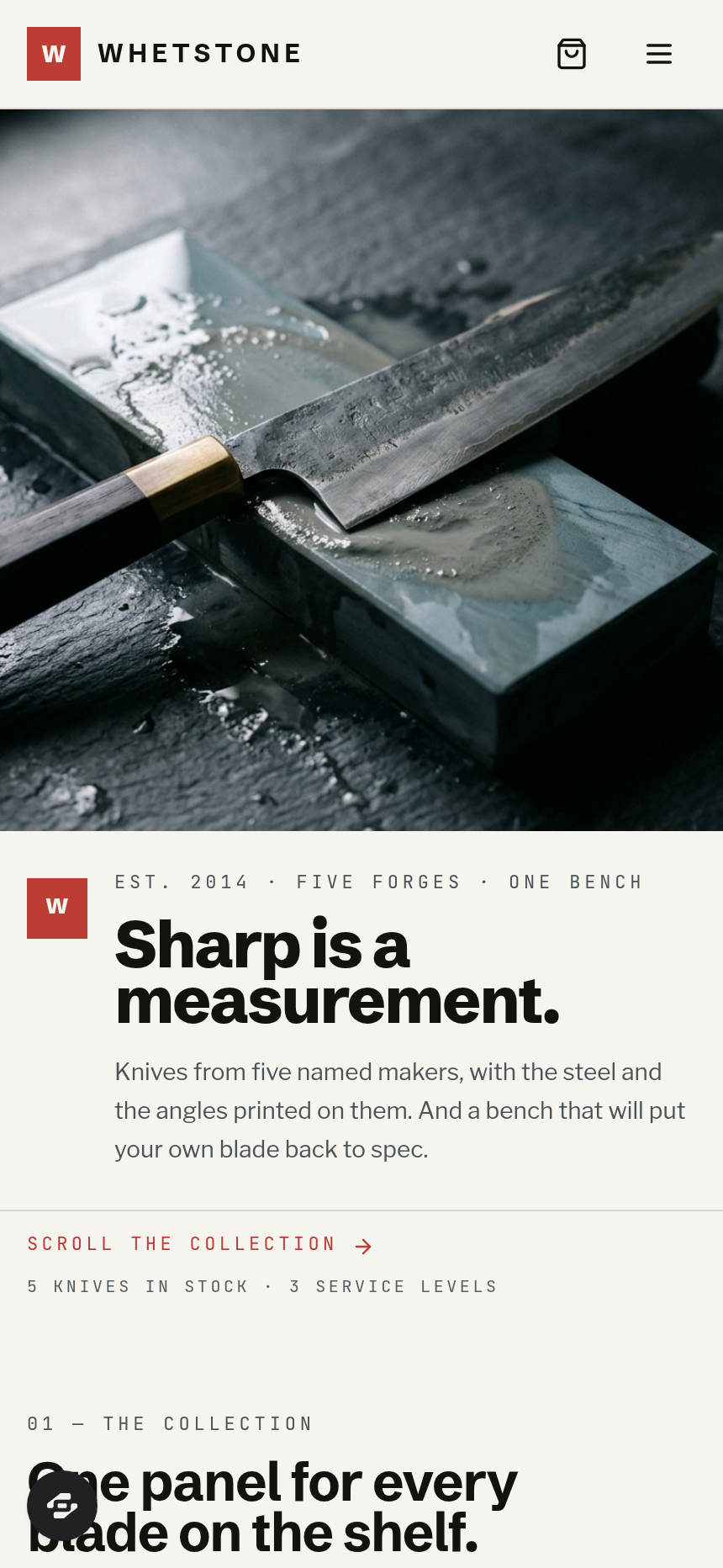
The styling is Japanese package design crossed with the Swiss typographic poster — great fields of cool paper white, one full-bleed photograph per panel, a vertical type rail running up the page edge, a single vermilion seal as the only ornament, and a horizontal snap-scrolling band of maker panels as the collection itself. It fits any shop where the object has specifications worth printing and a service attached: knives and stones, straight razors, hand tools and planes, fountain pens, bicycles and components, watches, instruments and audio gear.
Frequently asked questions
What is the Whetstone template?
How long does it take to build an app with the Whetstone template?
Do I need to code to use the Whetstone template?
How much does the Whetstone template cost?
Can I customize the Whetstone template?
Review current pricing and the template inspection guide before you start.
Related templates
 E-commerce
Bossbabe: Digital Shelf
A digital-product storefront where one offer + one funnel makes sales on repeat — editorial feminine-luxe.
 E-commerce
Grace & Grit
A faith-based fashion storefront with a full catalog, categories, cart, and newsletter.
 E-commerce
Dropline
Limited-drop storefront with countdown hype
 E-commerce
Bolt Buy
A single-product BUY NOW storefront — no cart
Make this template your starting point.
Inspect the preview, plan your changes, and test the workflow before you share it.
Use this template