

A workshop can be over while its promises are still open. Keep those promises in a short follow-up list: one responsible person, one next action, an allowed channel, a due time and evidence of completion for each commitment.
Work through the fictional employer workshop below, then download the editable follow-up worksheet. You can complete the exercise before choosing or building an app.
Keep the promise and its history together.
Harbor Fabrication · Fictional follow-up exercise
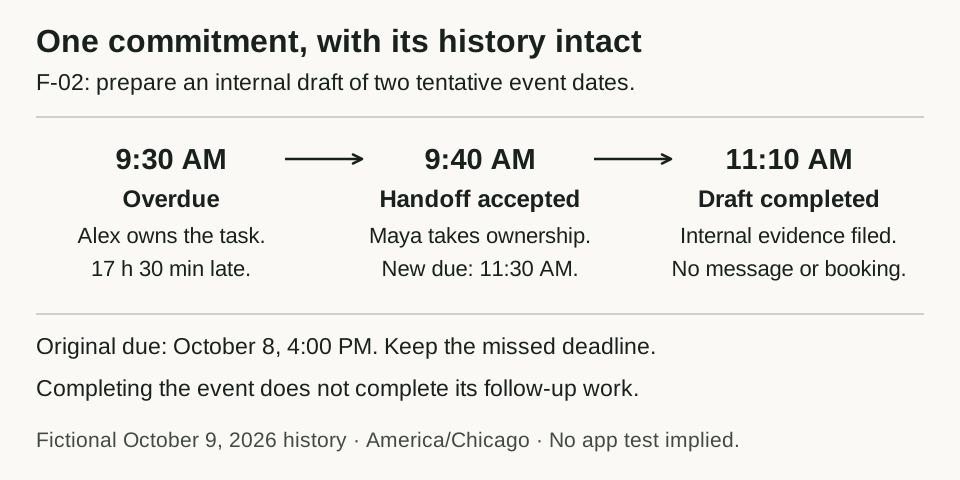
The worksheet's fictional F-02 history. Reassigning the work preserves the missed deadline; completing the internal draft does not establish a send or a confirmed event.
Open full-size follow-up historySeparate the event from its commitments
Harbor Fabrication hosted a lunch workshop on October 8, 2026, from noon to 1:00 PM. Maya coordinates the partnership, Alex supports event operations, and Jordan is the employer's host. The event and all people, dates, records and outcomes in this exercise are fictional. All times use America/Chicago.
The event record answers when the workshop happened. Each follow-up record answers what someone must do next.
Scroll horizontally to compare all columns.
| Milestone | Sample record | What it settles |
|---|---|---|
| Plan | October 6: event EV-01 created | There is a named event to attach work to |
| Confirm | October 7: host and room confirmation recorded | The sample workshop has an agreed time and place |
| Hold the workshop | October 8, 1:00 PM: event marked Completed | The workshop has finished |
| Review commitments | October 9, 9:30 AM: team review | Open promises still need individual attention |
Marking EV-01 Completed must not close its follow-up records. Likewise, changing a partner's pipeline stage should not erase the work attached to the event.
Turn a promise into a record someone can finish
At 2:00 PM on October 8, the sample team has this list. Each due time refers to the next action, including an internal review when external contact is on hold.
Scroll horizontally to compare all columns.
| ID | Owner | Next action | Due | State |
|---|---|---|---|---|
| F-01 | Maya | Send the promised recap to Jordan | Oct 9, 10:00 AM | Open |
| F-02 | Alex | Prepare two tentative dates for an internal review | Oct 8, 4:00 PM | Open |
| F-03 | Maya | Review whether any direct attendee follow-up was requested; record the permitted scope or keep contact on hold | Oct 9, noon | Waiting for permission review |
| F-04 | Alex | File the room-close checklist | Oct 8, 3:00 PM | Completed at 1:45 PM |
A team can help with a task, but one person owns its next action. If “Maya and Alex” appears in the owner field, choose which person is responsible for getting the next result recorded. Split a row when it contains two independently finishable promises.
Keep a stable ID, event, owner, next action, current due time and state together. Add the permission and channel record below, plus a history of ownership changes, deadlines and completion evidence.
Record the scope of contact before the channel
An email address tells you where a message could go. Record what the person asked for before deciding what to send.
Scroll horizontally to compare all columns.
| Commitment | Sample permission or restriction | Channel for this action |
|---|---|---|
| F-01 | Jordan requested one workshop recap at the closing conversation; sample note dated Oct 8, 1:00 PM | Jordan's agreed business email |
| F-02 | Internal preparation only; proposed dates have not been offered or accepted | Internal planning record; no message |
| F-03 | No direct attendee follow-up permission is recorded | Internal review only; external contact on hold |
| F-04 | Internal event documentation | Internal event record; no message |
The host's request for a recap does not give the team a new request from every attendee. Attendance alone should not turn F-03 into an email campaign. Keep permission unknown until there is a record that answers who requested contact, its purpose and allowed channel. Keep a withdrawn request in the history and stop the affected contact task.
Record only the business information needed for the commitment. This exercise does not need patient records, clinical notes, attendee health information or copies of a contact list.
Show overdue work without rewriting history
At the October 9 review, three commitments remain open. F-02 was due at 4:00 PM the day before, so it is 17 hours and 30 minutes overdue. F-01 is due in 30 minutes. F-03's internal review is due at noon. F-04 is already complete.
Use a simple definition: an open commitment is overdue when its current due time has passed. A waiting state still needs an owner and a next-review deadline. It does not remove the commitment from the open-work list.
Alex is unexpectedly unavailable. At 9:40 AM, Maya accepts F-02 and agrees to prepare the two-date draft by 11:30 AM. Record the handoff:
Scroll horizontally to compare all columns.
| Field | Before | After the accepted handoff |
|---|---|---|
| Owner | Alex | Maya |
| Next action | Prepare two tentative dates for internal review | Same action |
| Original due | Oct 8, 4:00 PM | Retained in history |
| Current due | Oct 8, 4:00 PM | Oct 9, 11:30 AM |
| Reason and time | No handoff | Alex unavailable; Maya accepted Oct 9, 9:40 AM |
| State | Open, overdue | Open, rescheduled after a missed deadline |
Maya is now the single owner. Merely suggesting her name should not remove Alex's responsibility before she accepts. The revised deadline changes which work is currently overdue; it does not make the original deadline successful.
Close the action that the evidence supports
At 11:10 AM, Maya files a draft listing October 20 and October 22 as unconfirmed options. F-02 is complete because its task was to prepare an internal draft. No future workshop has been booked and no message has been sent.
The sample completion entry reads:
F-02 · Completed October 9, 2026 at 11:10 AM, America/Chicago
Completed by: Maya
Result: Two tentative dates prepared for internal review.
Evidence: Internal date-options draft v1 attached to EV-01.
Boundary: Neither date is reserved, offered to Jordan or confirmed.
The attachment above is a fictional evidence description for the exercise. In your own app, attach or link the actual record and check that an authorized teammate can open it. For F-04, the sample evidence is room-close checklist v1, filed by Alex at 1:45 PM on October 8.
F-01 and F-03 remain open. At 11:10 AM, F-01 is now 1 hour and 10 minutes overdue. Do not let completing F-02 hide that missed recap. The open-work view should show:
Scroll horizontally to compare all columns.
| Commitment | Owner | Next action | Current due | Review result |
|---|---|---|---|---|
| F-01 | Maya | Send the promised recap to Jordan | Oct 9, 10:00 AM | Overdue by 1 hour 10 minutes |
| F-03 | Maya | Complete the permission review | Oct 9, noon | Waiting; review still due |
If a task asks someone to prepare a draft, a saved draft can finish it. If it asks someone to send a message, a draft cannot. Keep a sending record, delivery evidence and the recipient's reply distinct. A completed send must not automatically claim delivery or agreement. No outbound message is sent or demonstrated in this exercise.
Compare the plan with a real starting point
The ChiroPartner Events demo provides a public interface to inspect. A read-only review on October 6, 2026 found a Sample data label, event states, dates, venues and aggregate event figures. That review did not exercise saving, exporting or sending. Follow-up owner, permission/channel and next-action deadline fields were not observed on that Events view.
The commitment workflow in this guide is a proposed adaptation. Use the original MCP demonstration guide for the earlier build and test history; its sample calculations are separate from this planning exercise.
Bring your completed worksheet to a build request:
Adapt this partner-event app to track the commitments from my worksheet.
Keep event status separate from commitment status. Each open commitment
needs one owner, one next action, permission scope, channel and due time.
Waiting items need an internal next action and review deadline.

Use fictional EV-01 and F-01 through F-04 first. Preserve original due
times and assignment history. Change ownership only after the new owner
accepts. Show the October 9 overdue and reassignment examples accurately.
Require an actual evidence record before a task is marked complete.

Build an internal planning view. Do not send messages or import real
contacts. Report which worksheet checks pass, fail or remain unverified.
The ChiroPartner remix page offers signup or sign-in before continuing to a copy. Review current plans and credits. Opening that page does not establish a completed copy or a working follow-up system.
Use the worksheet to rehearse ownership, deadline and evidence changes in an authorized test copy. Then use the private-record access guide and launch checklist before introducing real business records or configuring any messages.