

Standpipe
Standpipe is the part of a fire, rescue or heavy-industry service that decides whether a crew can actually do the job on the worst night of the year.
About this template
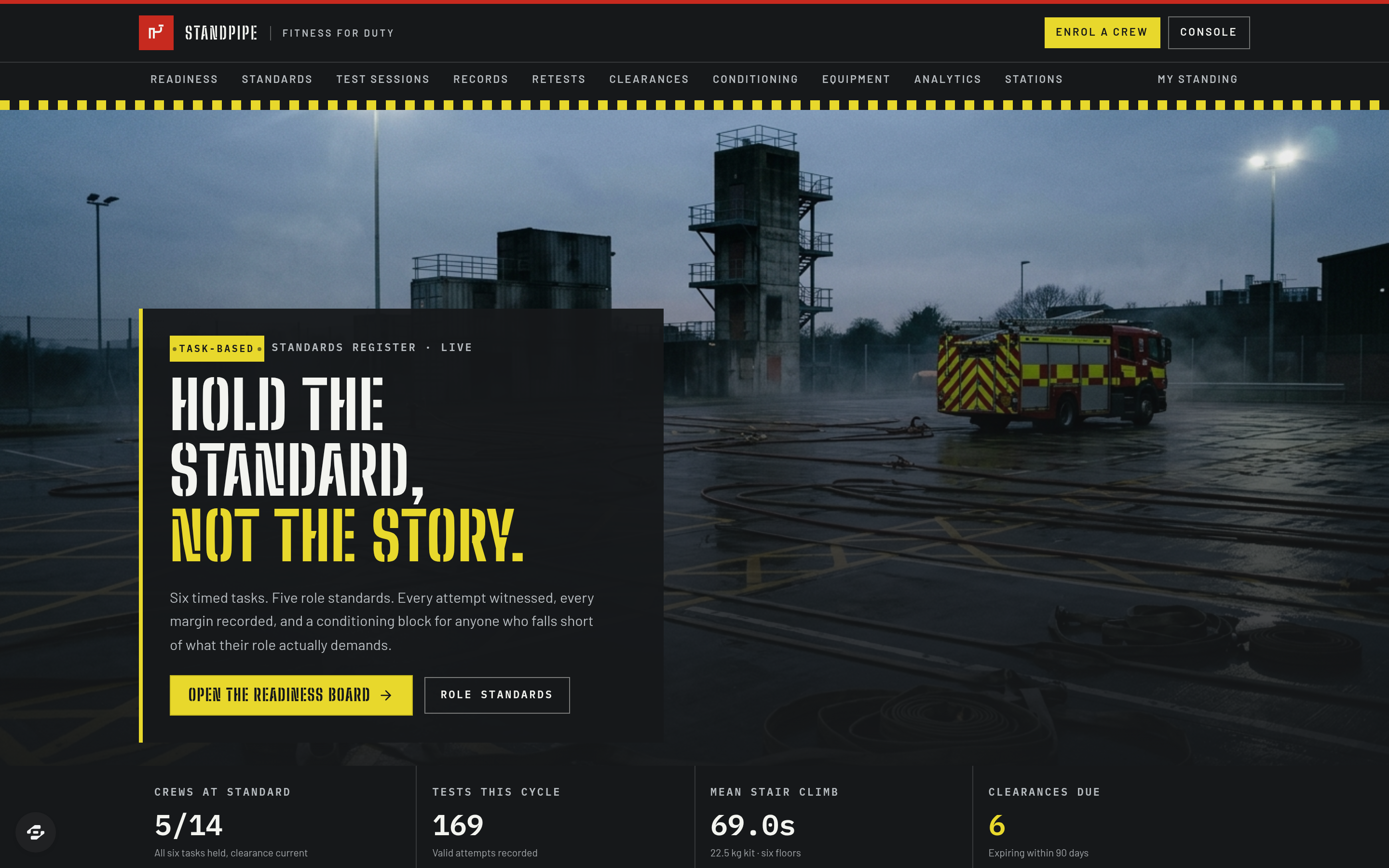
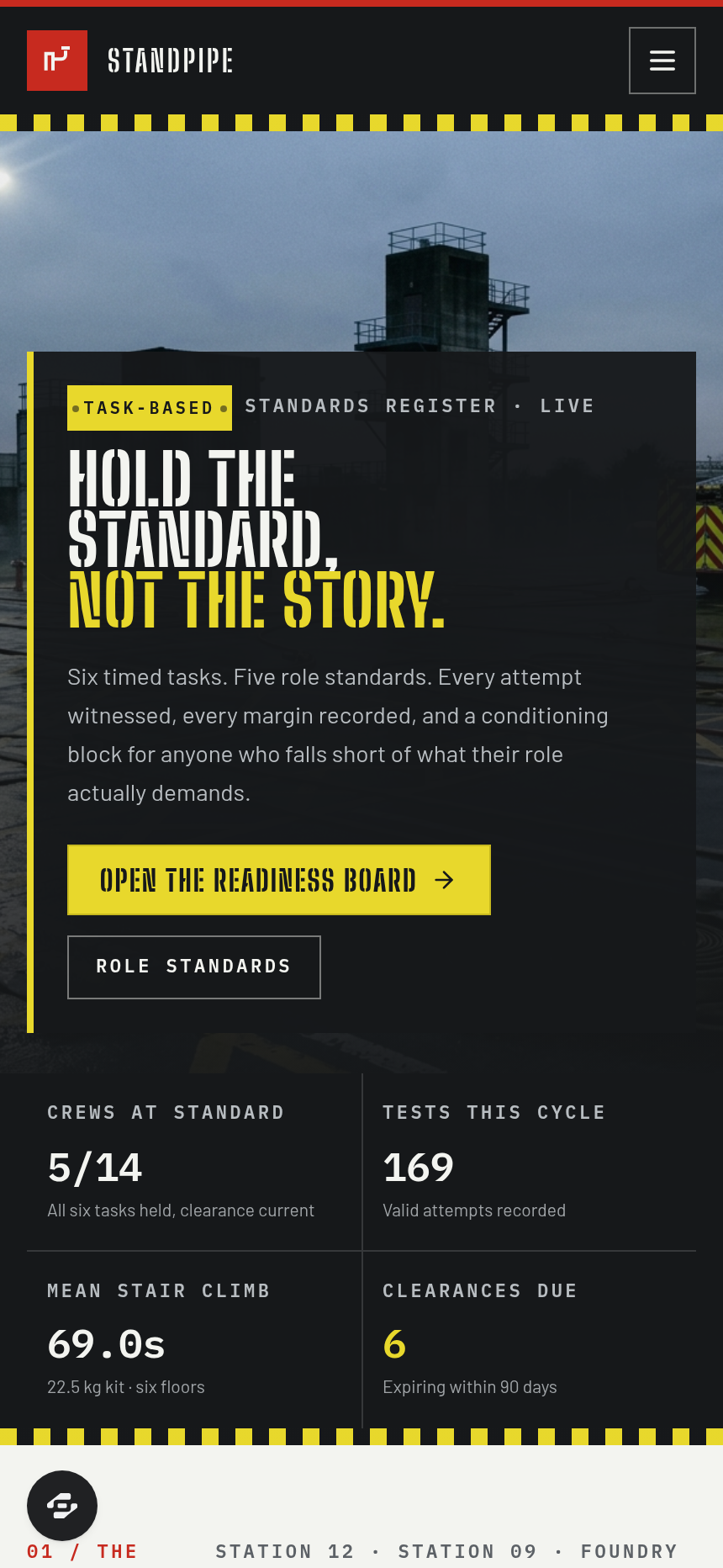
Standpipe is the part of a fire, rescue or heavy-industry service that decides whether a crew can actually do the job on the worst night of the year. It defines the physical standard each role must hold, runs the tests that prove it, and keeps the record honest — not a gym programme, a register.
The standards screen states, per role, each timed task with its load, its distance and its threshold: the charged-hose drag, the ladder raise, the stair climb in weighted kit, the casualty drag, the confined-space crawl, the equipment carry. A test session runs a whole crew through the battery with a stopwatch, per-attempt entry, invalid-attempt reasons and a witness sign-off, so a time on the page is a time somebody stood over.
The signature screen is the crew readiness board: every member gridded against every standard, colour-banded in-standard, marginal, short or expired, so the question "who is fit to ride tonight" is one glance rather than a phone call. Around it sit the things that keep it true — a due-and-retest ladder with attempts remaining, a medical clearance register with expiries and restrictions, a conditioning plan builder that prescribes real weekly work against the specific task someone failed with a re-test date attached, a testing-equipment and kit register with inspection dates, and a station analytics view charting pass rates by task and by station and mean times by age band. A member-facing view says in plain language exactly what that person has to hold and where they stand.
It is drawn in fire-service appliance livery and industrial safety signage — battenburg chevron bands, structural hazard banding, stencilled condensed type, high-visibility yellow on charcoal, with signal green reserved for in-standard states and nothing else. It suits any organisation where physical capability is a condition of the role: fire and rescue services, ambulance and HART teams, mine and offshore rescue, industrial emergency response teams, police and military candidate testing, and occupational-health providers who run the standards on their behalf.
Frequently asked questions
What is the Standpipe template?
How long does it take to build an app with the Standpipe template?
Do I need to code to use the Standpipe template?
How much does the Standpipe template cost?
Can I customize the Standpipe template?
Review current pricing and the template inspection guide before you start.
Related templates
 Fitness
Sentinel
The match-fixing and betting-irregularity register of a sport's integrity unit
 Fitness
Turnstile
The safety certificate and crowd-capacity record of a sports ground
 Fitness
Menkyo
The examination board, the syllabus and the rank register — the authority that decides who is what rank, and can prove it
 Fitness
Riposte
The bout ladder, piste bookings and the armoury — one hard operating system for a fencing club
Make this template your starting point.
Inspect the preview, plan your changes, and test the workflow before you share it.
Use this template